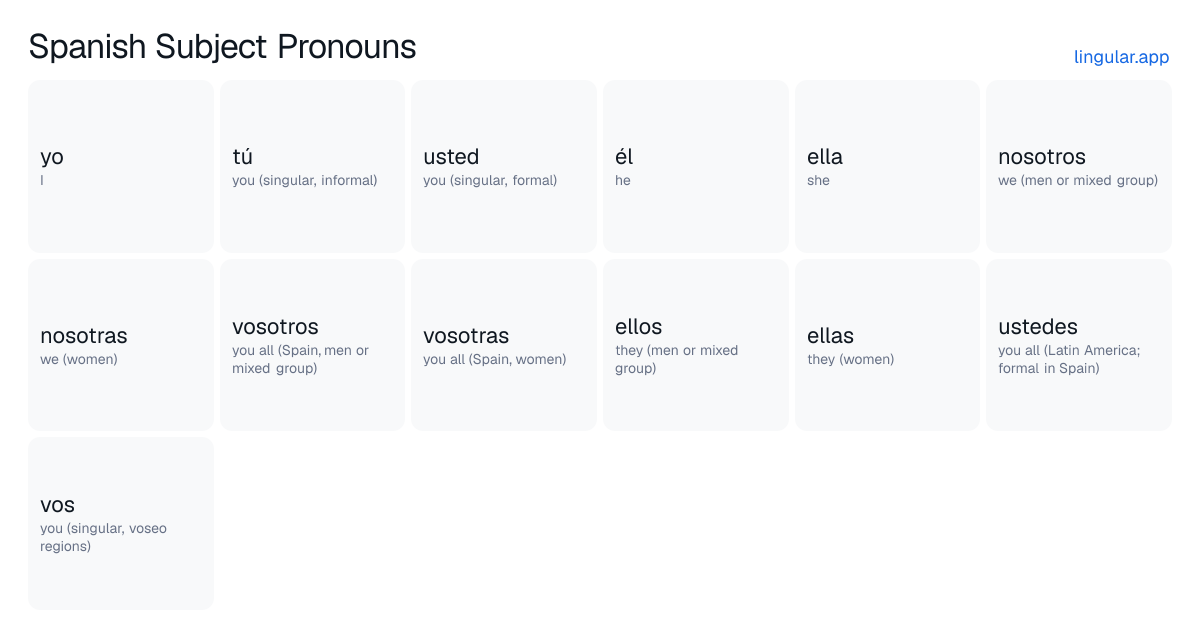
Yo, tú, él and the plural forms, including vosotros, ustedes and vos. Practise the complete set.
Step 1 of 3
Singular subject pronouns in Spanish
A subject pronoun tells you who does the action. Spanish often omits it: hablo already means I speak.
Tú and usted both address one person, but usted uses third-person verb forms: usted habla. See the common verbs for examples.
yoI · YOH
túyou (singular, informal) · TOO
ustedyou (singular, formal) · oos-TEHD
élhe · EL
ellashe · EH-yah
Plural Spanish subject pronouns
Use nosotras, vosotras and ellas for all-female groups. The -os forms are the standard grammatical forms for male or mixed groups.
The six verb persons are yo, tú, él/ella/usted, nosotros/nosotras, vosotros/vosotras and ellos/ellas/ustedes.
nosotroswe (men or mixed group) · noh-SOH-trohs
nosotraswe (women) · noh-SOH-trahs
vosotrosyou all (Spain, men or mixed group) · boh-SOH-trohs
vosotrasyou all (Spain, women) · boh-SOH-trahs
ellosthey (men or mixed group) · EH-yohs
ellasthey (women) · EH-yahs
Ustedes, vosotros and vos
In most of Latin America, ustedes covers plural you in both formal and informal contexts. Spain normally distinguishes informal vosotros from formal ustedes.
Singular vos is a separate regional form, not an abbreviation of vosotros. Compare questions with the question words.
ustedesyou all (Latin America; formal in Spain) · oos-TEH-dehs
vosyou (singular, voseo regions) · BOHS
learnt
0
mastered
0
learning
0
struggling
0
due for review
0
Learning Learnt Mastered Struggling
Pick a word to hear it and see when it's due next.
0 / 13 learnt
Spanish Subject Pronouns: the full list
Every term with pronunciation and notes. Use the printable worksheet to test yourself.
Quick answer:I is yo, you (singular, informal) is tú, you (singular, formal) is usted, he is él, and she is ella.
Yo; tú; él, ella or usted; nosotros or nosotras; vosotros or vosotras; ellos, ellas or ustedes. Pronouns in the same group share a verb form.
What is the difference between tú and usted?
Both mean singular you. Tú usually signals an informal relationship; usted often signals formality or respect, with usage varying by region.
When do you use vosotros?
Vosotros and vosotras are informal plural you in most of Spain. Most Latin American varieties use ustedes instead.
What does vos mean?
Vos is singular you in regions with voseo, including Argentina and Uruguay. Its verb forms are different from tú in many contexts.
Do Spanish sentences need a subject pronoun?
Often they do not: the verb ending identifies the person. Use a pronoun for emphasis, contrast or to make the subject clear.
Does Spanish have a subject pronoun for it?
There is no single general subject pronoun used exactly like English it. Spanish often omits the subject; él or ella can refer back to a grammatically masculine or feminine noun in suitable contexts.