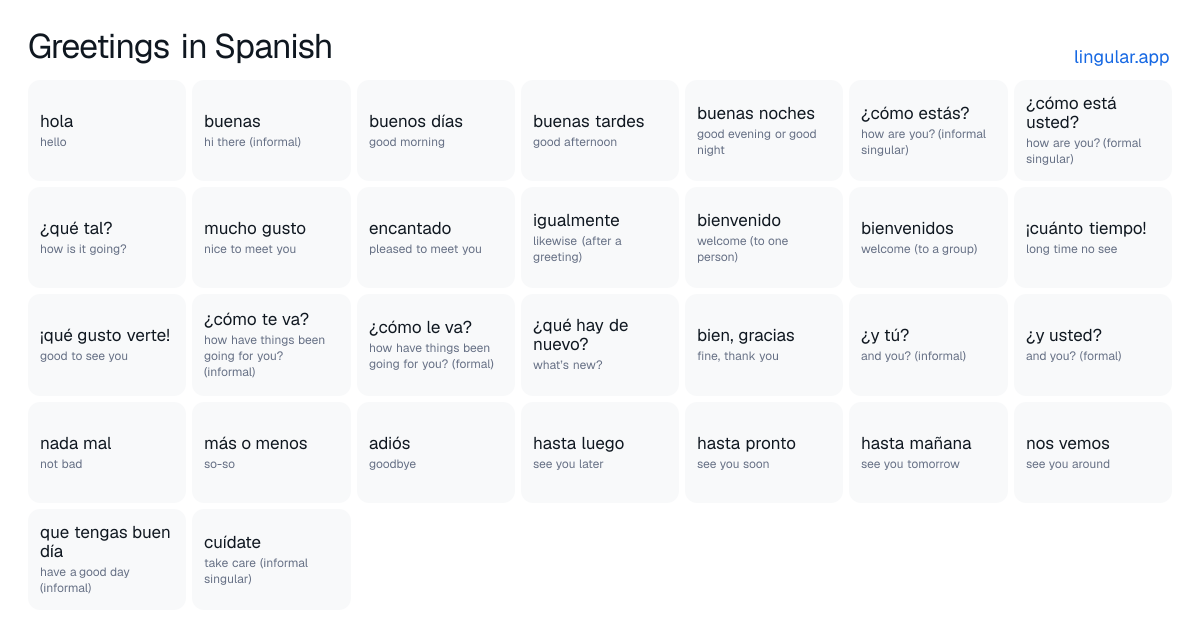
Choose a greeting for the time of day, a first meeting, a reunion or a polite farewell.
Step 1 of 3
Hello and good morning in Spanish
Hola works at any time. Buenos días, buenas tardes and buenas noches depend on the time of day; exact boundaries vary by place and routine.
These are fixed social expressions, so practice uses complete phrases. For other situations, see common Spanish phrases.
holahello · OH-lah
buenashi there (informal) · BWEH-nahs
buenos díasgood morning · BWEH-nohs DEE-ahs
buenas tardesgood afternoon · BWEH-nahs TAHR-dehs
buenas nochesgood evening or good night · BWEH-nahs NOH-chehs
¿cómo estás?how are you? (informal singular) · KOH-moh ehs-TAHS
¿cómo está usted?how are you? (formal singular) · KOH-moh ehs-TAH oos-TEHD
¿qué tal?how is it going? · keh TAHL
Spanish greetings for meeting someone
Mucho gusto and encantado are common first-meeting expressions. A woman normally says encantada about herself.
¿Cómo te va? uses informal singular te; ¿cómo le va? is a polite singular alternative. Review the people addressed in subject pronouns.
mucho gustonice to meet you · MOO-choh GOOS-toh
encantadopleased to meet you · ehn-kahn-TAH-doh
igualmentelikewise (after a greeting) · ee-gwahl-MEHN-teh
bienvenidowelcome (to one person) · byehn-beh-NEE-doh
bienvenidoswelcome (to a group) · byehn-beh-NEE-dohs
¡cuánto tiempo!long time no see · KWAHN-toh TYEHM-poh
¡qué gusto verte!good to see you · keh GOOS-toh BEHR-teh
¿cómo te va?how have things been going for you? (informal) · KOH-moh teh BAH
¿cómo le va?how have things been going for you? (formal) · KOH-moh leh BAH
¿qué hay de nuevo?what’s new? · keh eye deh NWEH-boh
How to answer greetings and say goodbye in Spanish
Replying with bien, gracias is neutral and polite. Add ¿y tú? or ¿y usted? to return the question.
Hasta luego does not always promise a meeting later the same day. Nos vemos is a relaxed way to end a conversation.
bien, graciasfine, thank you · BYEHN GRAH-syahs
¿y tú?and you? (informal) · ee TOO
¿y usted?and you? (formal) · ee oos-TEHD
nada malnot bad · NAH-dah MAHL
más o menosso-so · MAHS oh MEH-nohs
adiósgoodbye · ah-DYOHS
hasta luegosee you later · AHS-tah LWEH-goh
hasta prontosee you soon · AHS-tah PROHN-toh
hasta mañanasee you tomorrow · AHS-tah mah-NYAH-nah
nos vemossee you around · nohs BEH-mohs
que tengas buen díahave a good day (informal) · keh TEHN-gahs bwehn DEE-ah
cuídatetake care (informal singular) · KWEE-dah-teh
learnt
0
mastered
0
learning
0
struggling
0
due for review
0
Learning Learnt Mastered Struggling
Pick a word to hear it and see when it's due next.
0 / 30 learnt
Greetings in Spanish: the full list
Review the meanings and pronunciation, then use the printable worksheet to recall each Spanish answer.
Quick answer:hello is hola, hi there (informal) is buenas, good morning is buenos días, good afternoon is buenas tardes, good evening or good night is buenas noches, how are you? (informal singular) is ¿cómo estás?, how are you? (formal singular) is ¿cómo está usted?, and how is it going? is ¿qué tal?.