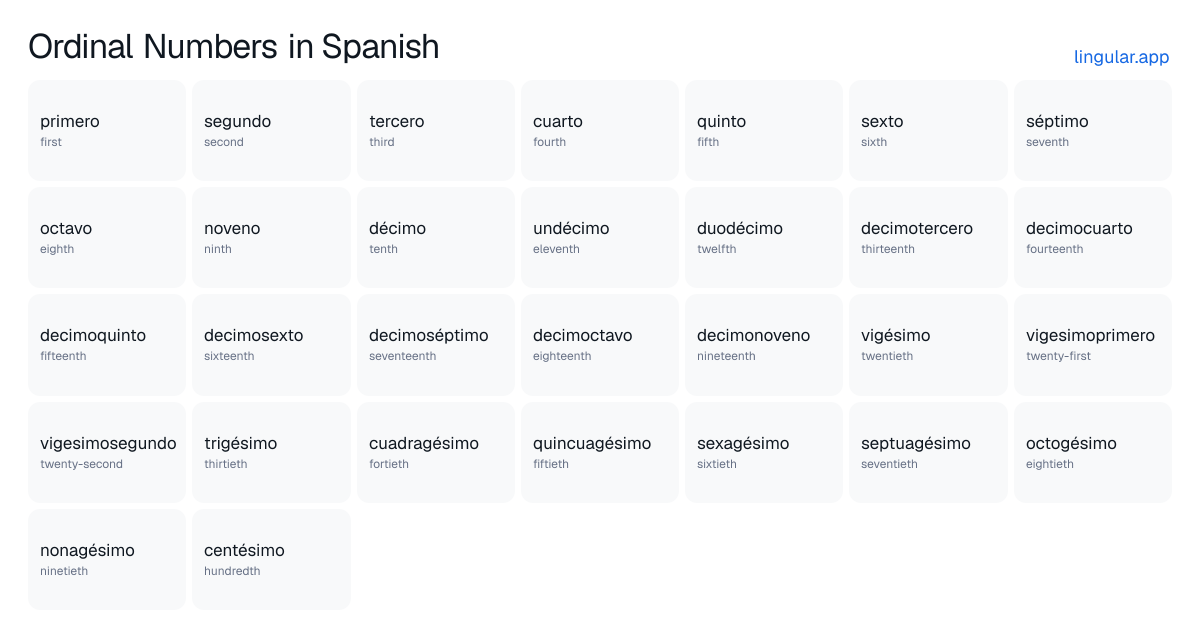
Learn first through twentieth, higher ranks, and the gender and spelling patterns that connect them.
Step 1 of 3
Spanish ordinal numbers from first to tenth
Ordinal numbers give position: primero means first, while uno counts one. Review counting separately in Spanish numbers.
Change -o to -a with a feminine noun: segunda página. Primero and tercero shorten to primer and tercer before a masculine singular noun.
primerofirst · pree-MEH-roh
segundosecond · seh-GOON-doh
tercerothird · tehr-SEH-roh
cuartofourth · KWAHR-toh
quintofifth · KEEN-toh
sextosixth · SEHKS-toh
séptimoseventh · SEP-tee-moh
octavoeighth · ohk-TAH-boh
novenoninth · noh-BEH-noh
décimotenth · DEH-see-moh
Spanish ordinal numbers from eleventh to twentieth
Undécimo and duodécimo coexist with decimoprimero and decimosegundo. Both forms are accepted here.
Joined forms have one written stress pattern: decimotercero has no accent, but decimoséptimo does. In two words, both parts change gender: décima tercera.
Twenty-first and higher ordinal numbers in Spanish
The twenties also allow joined or separate spellings: vigesimoprimero or vigésimo primero. A joined form loses the accent on its first element.
Above tenth, everyday Spanish often uses cardinal numbers for floors and chapters. These ordinal forms remain useful for rankings, anniversaries and formal writing.
Pick a word to hear it and see when it's due next.
0 / 30 learnt
Ordinal Numbers in Spanish: the full list
Review the meanings and pronunciation, then use the printable worksheet to recall each Spanish answer.
Quick answer:first is primero, second is segundo, third is tercero, fourth is cuarto, fifth is quinto, sixth is sexto, seventh is séptimo, eighth is octavo, ninth is noveno, and tenth is décimo.