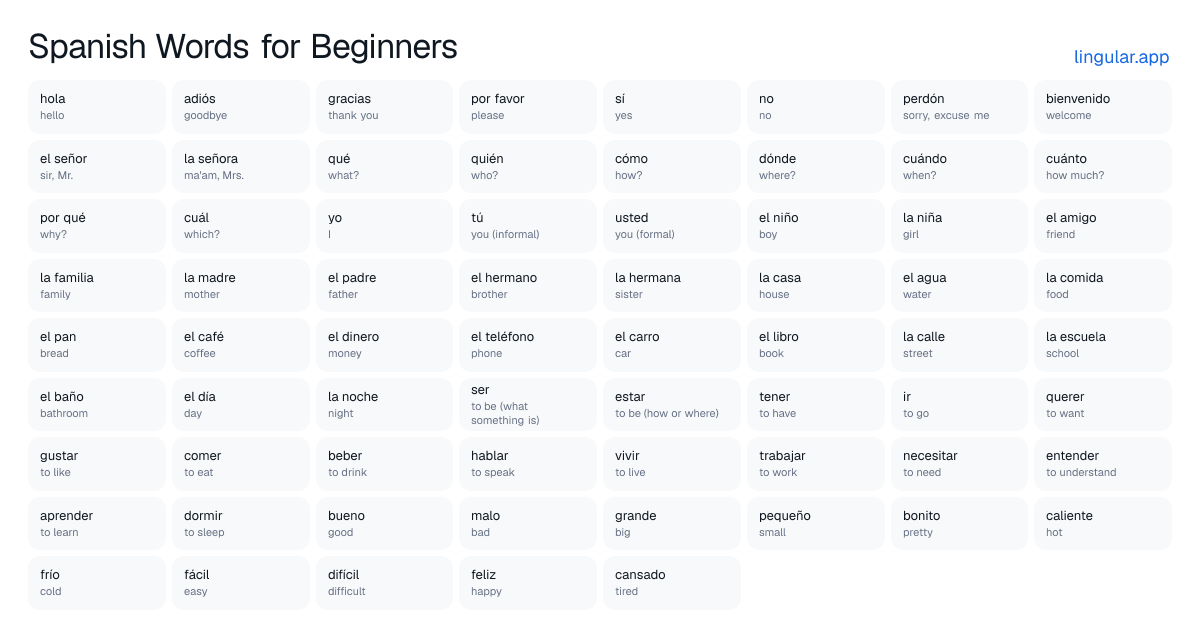
Every Spanish question word has a written accent, and a question opens with an upside-down mark: ¿dónde está?
Without the accent they join ideas instead: porque is because, ¿por qué? is why.
quéwhat? · KEH
quiénwho? · KYEN
cómohow? · KOH-moh
dóndewhere? · DOHN-deh
cuándowhen? · KWAHN-doh
cuántohow much? · KWAHN-toh
por quéwhy? · por KEH
cuálwhich? · KWAHL
Spanish words for people and family
Use tú with friends and family and usted with strangers. Yo is often left out, because the verb already says who: soy Ana, I'm Ana.
Many people words swap -o for -a: el niño, la niña. More relatives are on the family members page.
el niño+-o → -a=la niña
yoI · YOH
túyou (informal) · TOO
ustedyou (formal) · oos-TEHD
el niñoboy · el NEE-nyoh
la niñagirl · lah NEE-nyah
el amigofriend · el ah-MEE-goh
la familiafamily · lah fah-MEE-lyah
la madremother · lah MAH-dreh
el padrefather · el PAH-dreh
el hermanobrother · el ehr-MAH-noh
la hermanasister · lah ehr-MAH-nah
Basic Spanish nouns for everyday things
Learn each noun with el or la: it tells you whether the word is masculine or feminine. Most words ending in -o take el and most ending in -a take la, but it's el día.
la casahouse · lah KAH-sah
el aguawater · el AH-gwah
la comidafood · lah koh-MEE-dah
el panbread · el PAHN
el cafécoffee · el kah-FEH
el dineromoney · el dee-NEH-roh
el teléfonophone · el teh-LEH-foh-noh
el carrocar · el KAH-rroh
el librobook · el LEE-broh
la callestreet · lah KAH-yeh
la escuelaschool · lah ehs-KWEH-lah
el bañobathroom · el BAH-nyoh
el díaday · el DEE-ah
la nochenight · lah NOH-cheh
Basic Spanish verbs for beginners
Verbs are listed in the infinitive, ending in -ar, -er or -ir. Swap the ending for -o to talk about yourself: hablar, hablo, I speak.
Ser and estar both mean to be: ser for what something is, estar for how or where it is. Me gusta means I like.
hablar+-ar → -o=hablo
serto be (what something is) · SEHR
estarto be (how or where) · ehs-TAR
tenerto have · teh-NEHR
irto go · EER
quererto want · keh-REHR
gustarto like · goos-TAR
comerto eat · koh-MEHR
beberto drink · beh-BEHR
hablarto speak · ah-BLAR
vivirto live · bee-BEER
trabajarto work · trah-bah-HAR
necesitarto need · neh-seh-see-TAR
entenderto understand · en-ten-DEHR
aprenderto learn · ah-pren-DEHR
dormirto sleep · dor-MEER
Easy Spanish adjectives for beginners
Adjectives go after the noun and match it: un libro bueno, una casa buena. Adjectives ending in -e or a consonant don't change for feminine: una casa grande.
bueno+-o → -a=buena
buenogood · BWEH-noh
malobad · MAH-loh
grandebig · GRAHN-deh
pequeñosmall · peh-KEH-nyoh
bonitopretty · boh-NEE-toh
calientehot · kah-LYEN-teh
fríocold · FREE-oh
fácileasy · FAH-seel
difícildifficult · dee-FEE-seel
felizhappy · feh-LEES
cansadotired · kahn-SAH-doh
learnt
0
mastered
0
learning
0
struggling
0
due for review
0
Learning Learnt Mastered Struggling
Pick a word to hear it and see when it's due next.
Rankings loading
–#–You–XPNext player
–
Spanish words for beginners: the full list
Every word on this page with its pronunciation, and how it changes.
Quick answer:hello is hola, goodbye is adiós, thank you is gracias, please is por favor, yes is sí, no is no, sorry, excuse me is perdón, welcome is bienvenido, sir, Mr. is el señor, and ma'am, Mrs. is la señora.
Basic Spanish greetings and polite words
English
Spanish
Say it
Changes to
hello
hola
OH-lah
The h is silent.
goodbye
adiós
ah-DYOHS
Chao is the casual goodbye in much of Latin America.
thank you
gracias
GRAH-syahs
Muchas gracias, thank you very much. The answer is de nada.
please
por favor
por fah-BOR
yes
sí
SEE
Keep the accent: si without it means if.
no
no
NOH
Also not, before the verb: no sé, I don't know.
sorry, excuse me
perdón
pehr-DOHN
Lo siento for a real apology.
welcome
bienvenido
byen-beh-NEE-doh
bienvenida · bienvenidos · bienvenidas
sir, Mr.
el señor
el seh-NYOR
Señor García, Mr. García.
ma'am, Mrs.
la señora
lah seh-NYOH-rah
Señorita for a young woman.
Spanish question words
English
Spanish
Say it
Changes to
what?
qué
KEH
¿Qué es esto?, what is this?
who?
quién
KYEN
Quiénes for more than one person.
how?
cómo
KOH-moh
¿Cómo estás?, how are you?
where?
dónde
DOHN-deh
¿Dónde está el baño?, where is the bathroom?
when?
cuándo
KWAHN-doh
how much?
cuánto
KWAHN-toh
¿Cuánto cuesta?, how much is it? Cuántos for how many.
why?
por qué
por KEH
Porque, one word with no accent, means because.
which?
cuál
KWAHL
¿Cuál es tu nombre?, what is your name?
Spanish words for people and family
English
Spanish
Say it
Changes to
I
yo
YOH
you (informal)
tú
TOO
For friends and family. Tu without an accent means your.
you (formal)
usted
oos-TEHD
For strangers and polite situations.
boy
el niño
el NEE-nyoh
Los niños, children.
girl
la niña
lah NEE-nyah
friend
el amigo
el ah-MEE-goh
La amiga for a woman.
family
la familia
lah fah-MEE-lyah
mother
la madre
lah MAH-dreh
Mamá is the everyday word: mi mamá.
father
el padre
el PAH-dreh
Papá is the everyday word. Write the accent: papa is a potato.
brother
el hermano
el ehr-MAH-noh
The h is silent.
sister
la hermana
lah ehr-MAH-nah
Basic Spanish nouns for everyday things
English
Spanish
Say it
Changes to
house
la casa
lah KAH-sah
En casa, at home.
water
el agua
el AH-gwah
Feminine, but el agua: el agua fría.
food
la comida
lah koh-MEE-dah
Also a meal.
bread
el pan
el PAHN
coffee
el café
el kah-FEH
money
el dinero
el dee-NEH-roh
Plata in much of Latin America.
phone
el teléfono
el teh-LEH-foh-noh
A cell phone is el celular, or el móvil in Spain.
car
el carro
el KAH-rroh
Carro in Mexico and Colombia, coche in Spain, auto in Argentina and Chile.
book
el libro
el LEE-broh
street
la calle
lah KAH-yeh
school
la escuela
lah ehs-KWEH-lah
bathroom
el baño
el BAH-nyoh
day
el día
el DEE-ah
Masculine, though it ends in -a: buenos días.
night
la noche
lah NOH-cheh
Buenas noches, good night.
Basic Spanish verbs for beginners
English
Spanish
Say it
Changes to
to be (what something is)
ser
SEHR
soy · eres · es. For who or what something is: soy Ana.
to be (how or where)
estar
ehs-TAR
estoy · estás · está. For how and where: estoy bien, está aquí.
to have
tener
teh-NEHR
tengo · tienes · tiene. Also for age: tengo 30 años.
to go
ir
EER
voy · vas · va
to want
querer
keh-REHR
quiero · quieres · quiere
to like
gustar
goos-TAR
me gusta · te gusta · le gusta. Me gusta el café, I like coffee.
to eat
comer
koh-MEHR
como · comes · come
to drink
beber
beh-BEHR
bebo · bebes · bebe. Tomar is common in Latin America: tomar café.
to speak
hablar
ah-BLAR
hablo · hablas · habla. ¿Hablas inglés?, do you speak English?
to live
vivir
bee-BEER
vivo · vives · vive
to work
trabajar
trah-bah-HAR
trabajo · trabajas · trabaja
to need
necesitar
neh-seh-see-TAR
necesito · necesitas · necesita
to understand
entender
en-ten-DEHR
entiendo · entiendes · entiende. No entiendo, I don't understand.
to learn
aprender
ah-pren-DEHR
aprendo · aprendes · aprende
to sleep
dormir
dor-MEER
duermo · duermes · duerme
Easy Spanish adjectives for beginners
English
Spanish
Say it
Changes to
good
bueno
BWEH-noh
buena · buenos · buenas. Buen before a masculine noun: un buen día.
bad
malo
MAH-loh
mala · malos · malas. Mal before a masculine noun: un mal día.
big
grande
GRAHN-deh
grandes
small
pequeño
peh-KEH-nyoh
pequeña · pequeños · pequeñas
pretty
bonito
boh-NEE-toh
bonita · bonitos · bonitas. Lindo is common in Latin America.
hot
caliente
kah-LYEN-teh
calientes. For the weather, say hace calor.
cold
frío
FREE-oh
fría · fríos · frías. For the weather, say hace frío.