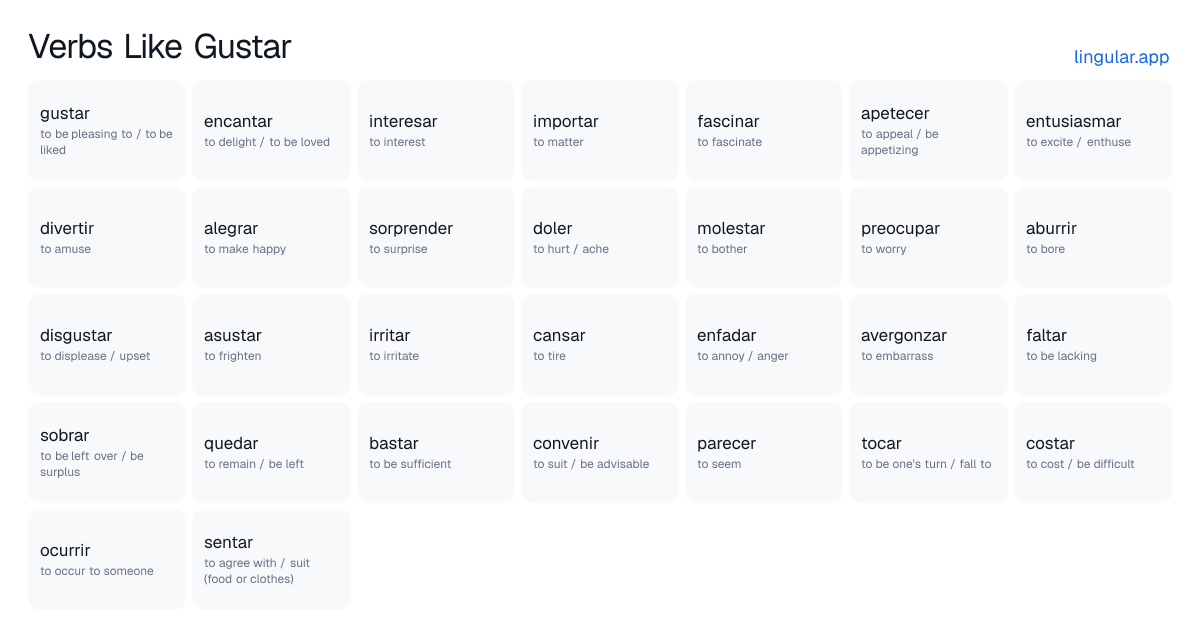
Learn verbs used with an affected person, from gustar and encantar to faltar and doler.
Step 1 of 3
Spanish verbs like gustar for liking and interest
In me gusta el libro, the book is the subject and me identifies the person who likes it. A plural subject gives me gustan los libros.
The practice asks for infinitives. Gustar is glossed as to be pleasing to so the Spanish subject relationship stays visible. Review subject pronouns alongside the verb forms.
gustarto be pleasing to / to be liked · goos-TAHR
encantarto delight / to be loved · ehn-kahn-TAHR
interesarto interest · een-teh-reh-SAHR
importarto matter · eem-por-TAHR
fascinarto fascinate · fah-see-NAHR
apetecerto appeal / be appetizing · ah-peh-teh-SEHR
Me duele la cabeza uses singular duele; me duelen los pies uses plural duelen. The painful body part controls agreement.
These verbs share useful patterns with me/te/nos, but they are not one identical grammatical class. Some emotion verbs also take direct objects; third-person lo/la/le depends on the verb and construction.
dolerto hurt / ache · doh-LEHR
molestarto bother · moh-lehs-TAHR
preocuparto worry · preh-oh-koo-PAHR
aburrirto bore · ah-boo-REER
disgustarto displease / upset · dees-goos-TAHR
asustarto frighten · ah-soos-TAHR
irritarto irritate · ee-ree-TAHR
cansarto tire · kahn-SAHR
enfadarto annoy / anger · ehn-fah-DAHR
avergonzarto embarrass · ah-behr-gohn-SAHR
Spanish verbs for needs and experiences
Me falta tiempo means I lack time, literally time is lacking to me. Me quedan dos días means I have two days left.
Me toca can mean it is my turn, while me cuesta can describe difficulty. These meanings differ from other uses of the same verbs; see common verbs for broader vocabulary.
faltarto be lacking · fahl-TAHR
sobrarto be left over / be surplus · soh-BRAHR
quedarto remain / be left · keh-DAHR
bastarto be sufficient · bahs-TAHR
convenirto suit / be advisable · kohn-beh-NEER
parecerto seem · pah-reh-SEHR
tocarto be one's turn / fall to · toh-KAHR
costarto cost / be difficult · kohs-TAHR
ocurrirto occur to someone · oh-koo-REER
sentarto agree with / suit (food or clothes) · sehn-TAHR
learnt
0
mastered
0
learning
0
struggling
0
due for review
0
Learning Learnt Mastered Struggling
Pick a word to hear it and see when it's due next.
0 / 30 learnt
Verbs Like Gustar: the full list
Review the vocabulary by topic, then use the printable worksheet to check your recall.
Quick answer:to be pleasing to / to be liked is gustar, to delight / to be loved is encantar, to interest is interesar, to matter is importar, to fascinate is fascinar, to appeal / be appetizing is apetecer, to excite / enthuse is entusiasmar, to amuse is divertir, to make happy is alegrar, and to surprise is sorprender.
In me gusta el café, café is the grammatical subject and me identifies the person pleased by it. English normally makes that person the subject: I like coffee.
When do you use gusta and gustan?
Use gusta with a singular noun or an infinitive, and gustan with a plural noun. Me gusta nadar and me gustan los libros illustrate the difference.
What are common verbs like gustar?
Encantar, interesar, importar, faltar and doler often occur in similar patterns with a person indicated by me, te, le, nos, os or les.
Does me encanta mean I love?
Yes, when expressing strong liking for an activity or thing. For example, me encanta leer means I love reading.
Are all these verbs grammatically identical?
No. They share useful patterns with an affected person, but some emotion verbs also use direct objects and other constructions.
What does me falta mean?
It means I lack something or something is missing for me. The verb agrees with what is missing: me falta tiempo, me faltan dos libros.