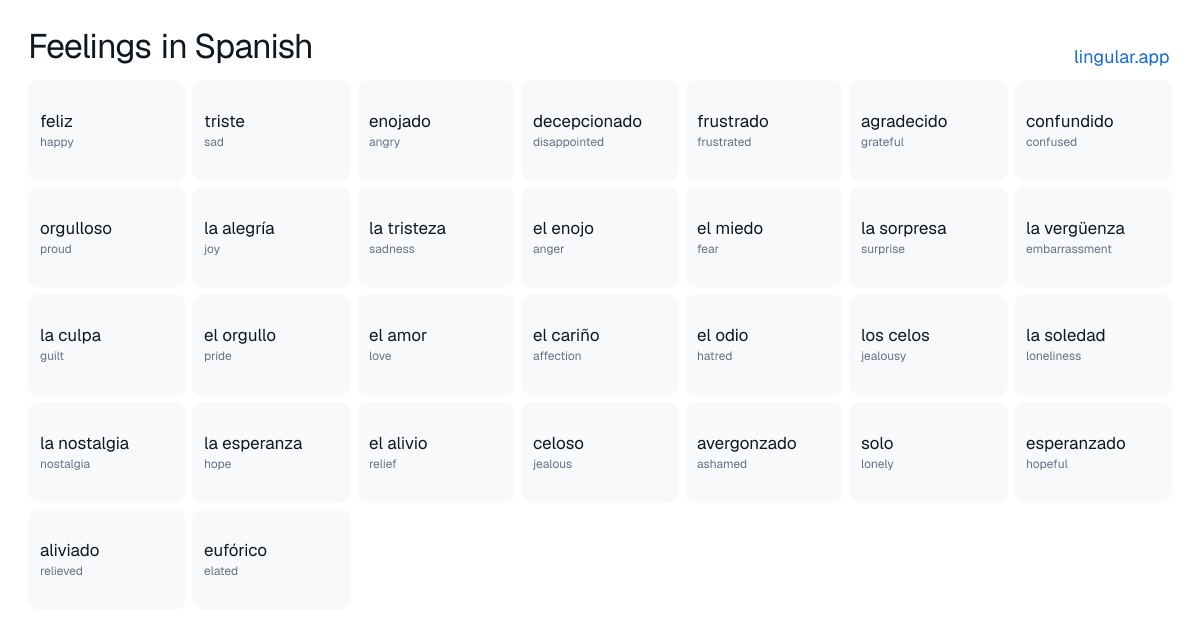
Name emotions and describe how you feel, from feliz and triste to alivio and esperanza.
Step 1 of 4
How to describe feelings in Spanish
Use estar for a current feeling: estoy triste. With sentirse, say me siento feliz.
Most adjectives ending in -o change to -a for a feminine subject. Feliz and triste do not change for gender. More general descriptions are in Spanish adjectives.
felizhappy · feh-LEES
tristesad · TREES-teh
enojadoangry · eh-noh-HAH-doh
decepcionadodisappointed · deh-sep-syoh-NAH-doh
frustradofrustrated · froos-TRAH-doh
agradecidograteful · ah-grah-deh-SEE-doh
confundidoconfused · kohn-foon-DEE-doh
orgullosoproud · or-goo-YOH-soh
Spanish emotion nouns
The feeling and its adjective are different words: la alegría is joy; feliz means happy.
Some feelings use tener: tengo miedo, I am afraid; tengo vergüenza, I feel embarrassed.
la alegríajoy · lah ah-leh-GREE-ah
la tristezasadness · lah trees-TEH-sah
el enojoanger · el eh-NOH-hoh
el miedofear · el MYEH-doh
la sorpresasurprise · lah sor-PREH-sah
la vergüenzaembarrassment · lah behr-GWEN-sah
la culpaguilt · lah KOOL-pah
el orgullopride · el or-GOO-yoh
Love, loneliness and hope in Spanish
El cariño is affection; el amor is love. Los celos is normally plural when it means jealousy.
Use sentir with an emotion noun: siento alivio. Find the infinitives in common verbs.
el amorlove · el ah-MOR
el cariñoaffection · el kah-REE-nyoh
el odiohatred · el OH-dyoh
los celosjealousy · lohs SEH-lohs
la soledadloneliness · lah soh-leh-DAHD
la nostalgianostalgia · lah nohs-TAHL-hyah
la esperanzahope · lah ehs-peh-RAHN-sah
el aliviorelief · el ah-LEE-byoh
More Spanish words for feelings
Me siento solo describes loneliness. Estoy solo can describe being physically alone without saying how you feel.
The feminine forms celosa, avergonzada and aliviada are accepted in practice.
celosojealous · seh-LOH-soh
avergonzadoashamed · ah-behr-gohn-SAH-doh
sololonely · SOH-loh
esperanzadohopeful · ehs-peh-rahn-SAH-doh
aliviadorelieved · ah-lee-BYAH-doh
eufóricoelated · ew-FOH-ree-koh
learnt
0
mastered
0
learning
0
struggling
0
due for review
0
Learning Learnt Mastered Struggling
Pick a word to hear it and see when it's due next.
0 / 30 learnt
Feelings in Spanish: the full list
Every term with pronunciation and notes. Use the printable worksheet to test yourself.
Quick answer:happy is feliz, sad is triste, angry is enojado, disappointed is decepcionado, frustrated is frustrado, grateful is agradecido, confused is confundido, and proud is orgulloso.