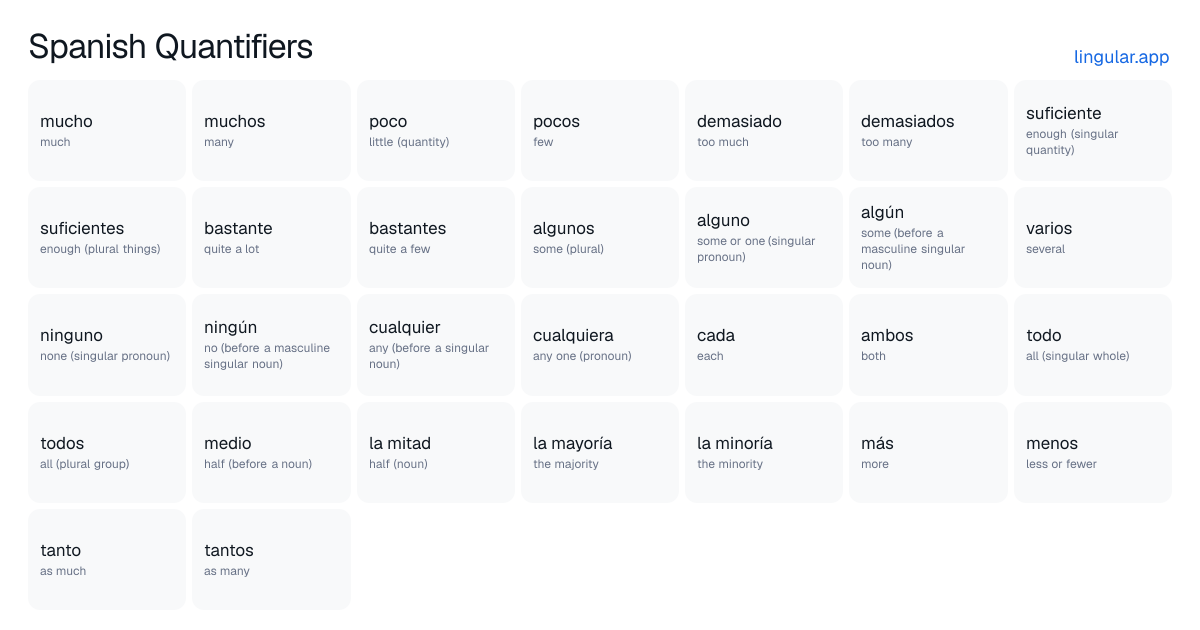
Alguno shortens to algún before a masculine singular noun; ninguno becomes ningún. Cada does not change: cada día, cada semana.
Cualquier goes before a singular noun, while cualquiera is used independently or after a noun. The prompts name those contexts explicitly.
algunossome (plural) · ahl-GOO-nohs
algunosome or one (singular pronoun) · ahl-GOO-noh
algúnsome (before a masculine singular noun) · ahl-GOON
variosseveral · BAH-ryohs
ningunonone (singular pronoun) · neen-GOO-noh
ningúnno (before a masculine singular noun) · neen-GOON
cualquierany (before a singular noun) · kwahl-KYEHR
cualquieraany one (pronoun) · kwahl-KYEH-rah
cadaeach · KAH-dah
ambosboth · AHM-bohs
All, half, more and less in Spanish
Todo can mean everything or all of something; todos refers to all members of a plural group. Medio changes gender when it means half before a noun: media hora.
Más and menos do not change for gender or number. For exact quantities, use Spanish numbers.
todoall (singular whole) · TOH-doh
todosall (plural group) · TOH-dohs
mediohalf (before a noun) · MEH-dyoh
la mitadhalf (noun) · lah mee-TAHD
la mayoríathe majority · lah mah-yoh-REE-ah
la minoríathe minority · lah mee-noh-REE-ah
másmore · MAHS
menosless or fewer · MEH-nohs
tantoas much · TAHN-toh
tantosas many · TAHN-tohs
learnt
0
mastered
0
learning
0
struggling
0
due for review
0
Learning Learnt Mastered Struggling
Pick a word to hear it and see when it's due next.
0 / 30 learnt
Spanish Quantifiers: the full list
Review the meanings and pronunciation, then use the printable worksheet to recall each Spanish answer.
Quick answer:much is mucho, many is muchos, little (quantity) is poco, few is pocos, too much is demasiado, too many is demasiados, enough (singular quantity) is suficiente, enough (plural things) is suficientes, quite a lot is bastante, and quite a few is bastantes.
Quantifiers express amount, number or proportion. Examples include mucho, poco, varios, cada and todo.
Do mucho and poco change for gender?
Before nouns they agree: mucha agua, pocas sillas. When they modify a verb as adverbs, they remain mucho and poco.
What is the difference between algún and alguno?
Algún comes before a masculine singular noun, as in algún libro. Alguno can stand independently.
Does cada have a plural form?
Cada is invariable and normally comes before a singular noun, such as cada estudiante. It can also occur with a number in expressions like cada dos días.
What is the difference between medio and mitad?
Medio can mean half before a noun, as in media hora. Mitad is a noun, as in la mitad del pastel.
Do más and menos change for gender or number?
No. Use the same forms in más agua, más libros, menos agua and menos libros.