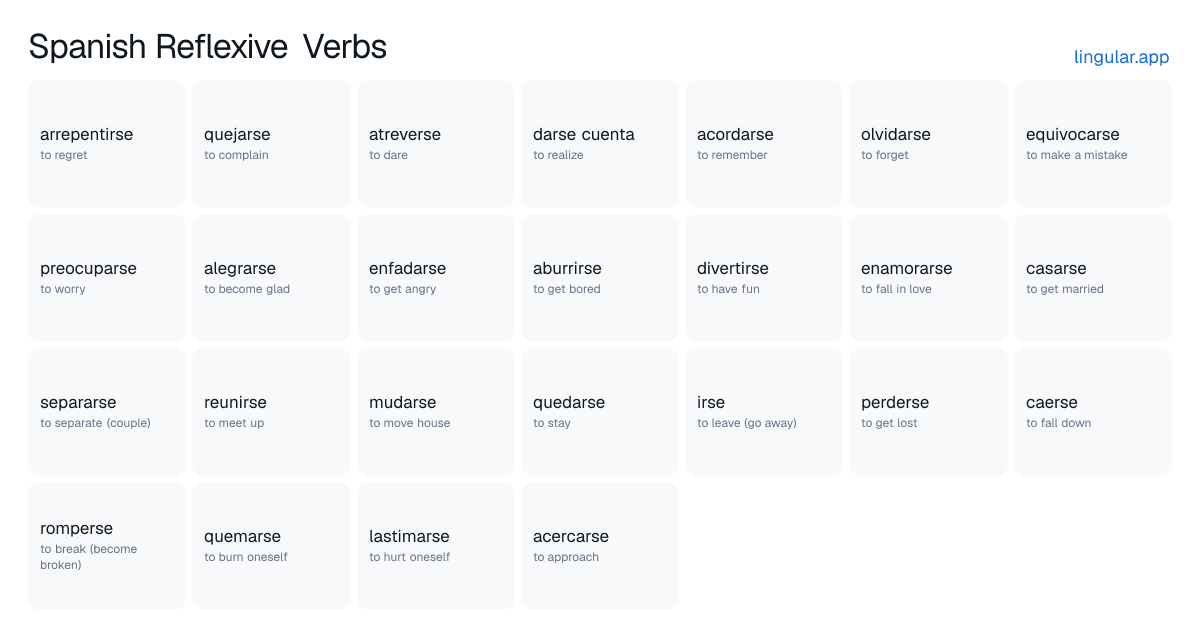
Learn -se verbs for reactions, decisions and changes, beyond the daily routine.
Step 1 of 3
Spanish -se verbs for thoughts and decisions
The infinitive ends in -se, but the pronoun changes with the subject: me, te, se, nos, os, se. For example, me arrepiento means I regret it.
Many verbs commonly taught as reflexive are technically pronominal: quejarse does not mean to complain to yourself. Review subject pronouns.
arrepentirseto regret · ah-rreh-pehn-TEER-seh
quejarseto complain · keh-HAHR-seh
atreverseto dare · ah-treh-BEHR-seh
darse cuentato realize · DAHR-seh KWEHN-tah
acordarseto remember · ah-kor-DAHR-seh
olvidarseto forget · ohl-bee-DAHR-seh
equivocarseto make a mistake · eh-kee-boh-KAHR-seh
preocuparseto worry · preh-oh-koo-PAHR-seh
Spanish pronominal verbs for reactions
Alegrarse means to become glad or be pleased; alegrar can mean to make someone else happy. Adding -se can change how a verb works.
For the adjectives that describe the resulting state, see feelings.
alegrarseto become glad · ah-leh-GRAHR-seh
enfadarseto get angry · ehn-fah-DAHR-seh
aburrirseto get bored · ah-boo-RREER-seh
divertirseto have fun · dee-behr-TEER-seh
enamorarseto fall in love · eh-nah-moh-RAHR-seh
casarseto get married · kah-SAHR-seh
separarseto separate (couple) · seh-pah-RAHR-seh
reunirseto meet up · rreh-oo-NEER-seh
Spanish -se verbs for movement and changes
Compare ir with irse: the first is to go, the second emphasizes leaving. Quedarse is to stay or remain.
Not every -se expresses a deliberate action on yourself. Caerse describes falling, and romperse can describe something breaking.
mudarseto move house · moo-DAHR-seh
quedarseto stay · keh-DAHR-seh
irseto leave (go away) · EER-seh
perderseto get lost · pehr-DEHR-seh
caerseto fall down · kah-EHR-seh
romperseto break (become broken) · rrohm-PEHR-seh
quemarseto burn oneself · keh-MAHR-seh
lastimarseto hurt oneself · lahs-tee-MAHR-seh
acercarseto approach · ah-sehr-KAHR-seh
learnt
0
mastered
0
learning
0
struggling
0
due for review
0
Learning Learnt Mastered Struggling
Pick a word to hear it and see when it's due next.
0 / 25 learnt
Spanish Reflexive Verbs: full list
Review the meanings, pronunciation and usage notes, then use the printable worksheet to recall the Spanish.
Quick answer:to regret is arrepentirse, to complain is quejarse, to dare is atreverse, to realize is darse cuenta, to remember is acordarse, to forget is olvidarse, to make a mistake is equivocarse, and to worry is preocuparse.
A truly reflexive use describes an action returning to the subject. Courses also often group pronominal verbs ending in -se under this heading, although their meanings are not always reflexive.
What happens to se when I say I?
Use me with yo: me quejo, I complain. The pronouns are me, te, se, nos, os and se.
Does arrepentirse mean to regret yourself?
No. It is a pronominal verb meaning to regret or repent, commonly followed by de. Its pronoun is part of the verb’s construction.
What is the difference between ir and irse?
Ir means to go, often toward a destination. Irse emphasizes leaving or going away.
Where does the pronoun go with an infinitive?
It attaches to a standalone infinitive, as in arrepentirse. With a conjugated verb it normally comes before: me arrepiento.
Why does acordarse need de?
Acordarse normally takes de before what is remembered. Recordar expresses remembering with a direct object instead.