Learn fixed expressions through their intended meaning, with notes on when to use them.
Step 1 of 3
Common Spanish idioms and their meanings
Meter la pata means to put your foot in it or make a blunder. Translate the meaning, not each separate word.
These are informal expressions. Review common verbs to change their infinitives for a person and tense.
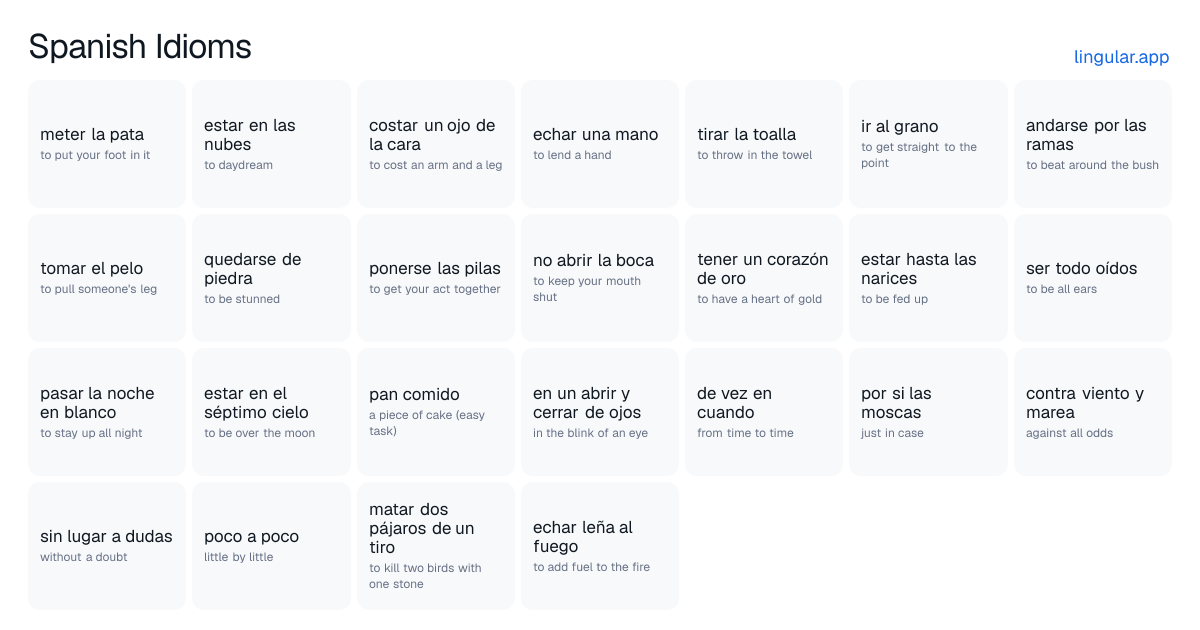
meter la patato put your foot in it · meh-TEHR lah PAH-tah
estar en las nubesto daydream · ehs-TAHR ehn lahs NOO-behs
costar un ojo de la carato cost an arm and a leg · kohs-TAHR oon OH-hoh deh lah KAH-rah
echar una manoto lend a hand · eh-CHAHR OO-nah MAH-noh
tirar la toallato throw in the towel · tee-RAHR lah toh-AH-yah
ir al granoto get straight to the point · eer ahl GRAH-noh
andarse por las ramasto beat around the bush · ahn-DAHR-seh por lahs RRAH-mahs
tomar el peloto pull someone's leg · toh-MAHR el PEH-loh
Spanish idioms for feelings and reactions
An idiom can describe a feeling without naming it directly. Quedarse de piedra suggests being stunned; ponerse las pilas asks for energy and action.
Compare their meanings with the literal vocabulary in feelings.
quedarse de piedrato be stunned · keh-DAHR-seh deh PYEH-drah
ponerse las pilasto get your act together · poh-NEHR-seh lahs PEE-lahs
no abrir la bocato keep your mouth shut · noh ah-BREER lah BOH-kah
tener un corazón de oroto have a heart of gold · teh-NEHR oon koh-rah-SOHN deh OH-roh
estar hasta las naricesto be fed up · ehs-TAHR AHS-tah lahs nah-REE-sehs
ser todo oídosto be all ears · sehr TOH-doh oh-EE-dohs
pasar la noche en blancoto stay up all night · pah-SAHR lah NOH-cheh ehn BLAHN-koh
estar en el séptimo cieloto be over the moon · ehs-TAHR ehn el SEHP-tee-moh SYEH-loh
Spanish idioms about luck, speed and difficulty
Some expressions work as short units without a verb: de vez en cuando means from time to time. Others need a conjugated verb in a sentence.
These examples are useful across many contexts, but idiom frequency and preferred wording vary by region.
pan comidoa piece of cake (easy task) · pahn koh-MEE-doh
en un abrir y cerrar de ojosin the blink of an eye · ehn oon ah-BREER ee seh-RRAHR deh OH-hohs
de vez en cuandofrom time to time · deh BEHS ehn KWAHN-doh
por si las moscasjust in case · por see lahs MOHS-kahs
contra viento y mareaagainst all odds · KOHN-trah BYEHN-toh ee mah-REH-ah
sin lugar a dudaswithout a doubt · seen loo-GAHR ah DOO-dahs
poco a pocolittle by little · POH-koh ah POH-koh
matar dos pájaros de un tiroto kill two birds with one stone · mah-TAHR dohs PAH-hah-rohs deh oon TEE-roh
echar leña al fuegoto add fuel to the fire · eh-CHAHR LEH-nyah ahl FWEH-goh
learnt
0
mastered
0
learning
0
struggling
0
due for review
0
Learning Learnt Mastered Struggling
Pick a word to hear it and see when it's due next.
0 / 25 learnt
Spanish Idioms: full list
Review the meanings, pronunciation and usage notes, then use the printable worksheet to recall the Spanish.
Quick answer:to put your foot in it is meter la pata, to daydream is estar en las nubes, to cost an arm and a leg is costar un ojo de la cara, to lend a hand is echar una mano, to throw in the towel is tirar la toalla, to get straight to the point is ir al grano, to beat around the bush is andarse por las ramas, and to pull someone's leg is tomar el pelo.
An idiom is a fixed expression whose intended meaning may not follow from its individual words. Estar en las nubes describes distraction or daydreaming.
What does meter la pata mean?
It means to make a blunder or put your foot in it. The literal image is putting a paw or leg somewhere.
How do you say a piece of cake in Spanish?
For an easy task, say pan comido, as in es pan comido. A literal slice of cake needs a different translation.
Can you conjugate Spanish idioms?
Yes, when the expression contains a verb: metí la pata means I put my foot in it. The fixed words around the verb usually stay together.
Are Spanish idioms formal?
Many are conversational, including por si las moscas and estar hasta las narices. A neutral expression may be more suitable in formal writing.
What does tomar el pelo mean?
It means to tease or pull someone’s leg. Me estás tomando el pelo means you are pulling my leg.