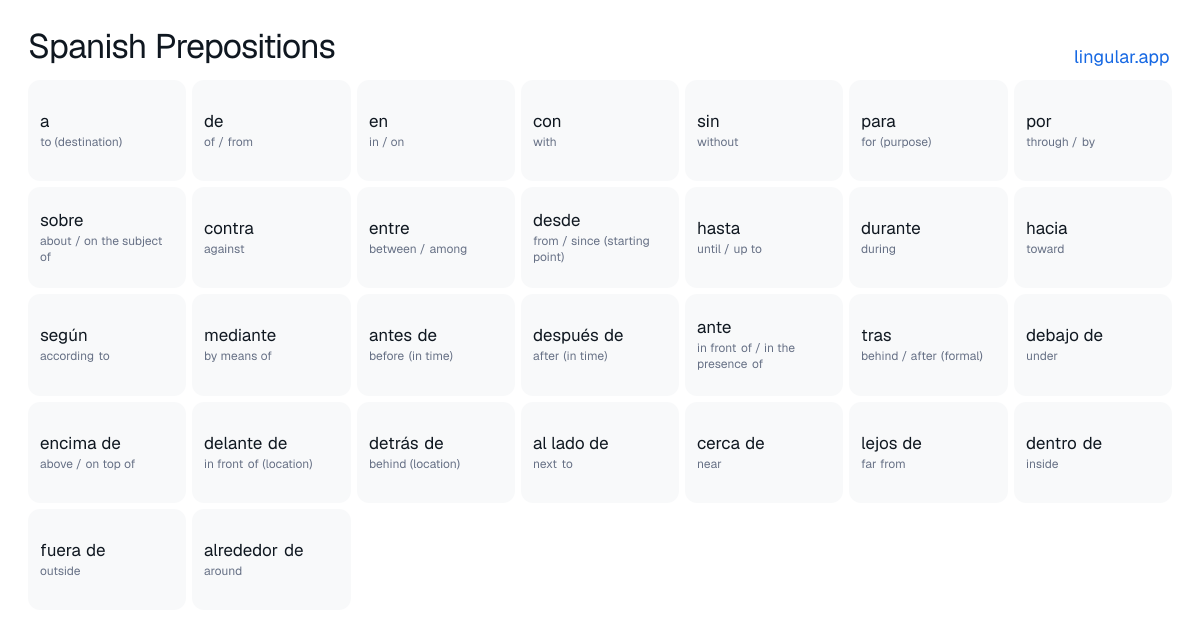
Connect places, times and ideas with a, de, en, por and para.
Step 1 of 3
Common Spanish prepositions
A often marks a destination; de marks origin or possession. A + el becomes al, and de + el becomes del.
English prepositions do not map one-to-one onto Spanish. Learn the relationship as well as the word; common verbs supply useful partners.
ato (destination) · AH
deof / from · DEH
enin / on · EN
conwith · KOHN
sinwithout · SEEN
parafor (purpose) · PAH-rah
porthrough / by · POR
sobreabout / on the subject of · SOH-breh
contraagainst · KOHN-trah
entrebetween / among · EN-treh
Spanish prepositions for time and movement
Desde gives a starting point and hasta an endpoint: desde lunes hasta viernes. Durante covers a period.
Por can give a reason or a route; para can give a purpose or recipient. Hacia means toward, without promising arrival.
desdefrom / since (starting point) · DEHS-deh
hastauntil / up to · AHS-tah
duranteduring · doo-RAHN-teh
haciatoward · AH-syah
segúnaccording to · seh-GOON
medianteby means of · meh-DYAHN-teh
antes debefore (in time) · AHN-tehs deh
después deafter (in time) · dehs-PWEHS deh
antein front of / in the presence of · AHN-teh
trasbehind / after (formal) · TRAHS
Spanish prepositional phrases for location
Multiword prepositions work as units: debajo de la mesa, under the table. Keep de when a noun follows.
Entre needs no extra de. Practice these relationships with house vocabulary.
debajo deunder · deh-BAH-hoh deh
encima deabove / on top of · en-SEE-mah deh
delante dein front of (location) · deh-LAHN-teh deh
detrás debehind (location) · deh-TRAHS deh
al lado denext to · ahl LAH-doh deh
cerca denear · SEHR-kah deh
lejos defar from · LEH-hohs deh
dentro deinside · DEHN-troh deh
fuera deoutside · FWEH-rah deh
alrededor dearound · ahl-reh-deh-DOR deh
learnt
0
mastered
0
learning
0
struggling
0
due for review
0
Learning Learnt Mastered Struggling
Pick a word to hear it and see when it's due next.
0 / 30 learnt
Spanish Prepositions: the full list
Review the vocabulary by topic, then use the printable worksheet to check your recall.
Quick answer:to (destination) is a, of / from is de, in / on is en, with is con, without is sin, for (purpose) is para, through / by is por, about / on the subject of is sobre, against is contra, and between / among is entre.
A, de, en, con, sin, por and para are frequent starting points. Their English translation depends on the relationship expressed.
What is the difference between por and para?
Para often marks purpose, destination or recipient; por often marks cause, exchange or movement through a place. These are useful starting patterns, not a complete rule for every use.
When do a and de contract?
A + el becomes al and de + el becomes del. Neither contracts with él, the pronoun meaning he or him.
Does en mean in or on?
En can mean both in and on. Context tells you whether en la mesa means on the table or at the table.
Do location expressions need de?
Many do when a noun follows: cerca de casa and debajo de la mesa. A standalone adverb can omit it, as in está cerca.
What is the personal a?
Spanish normally puts a before a specific person who is a direct object: veo a Ana. It is a grammatical marker, not the English word to.