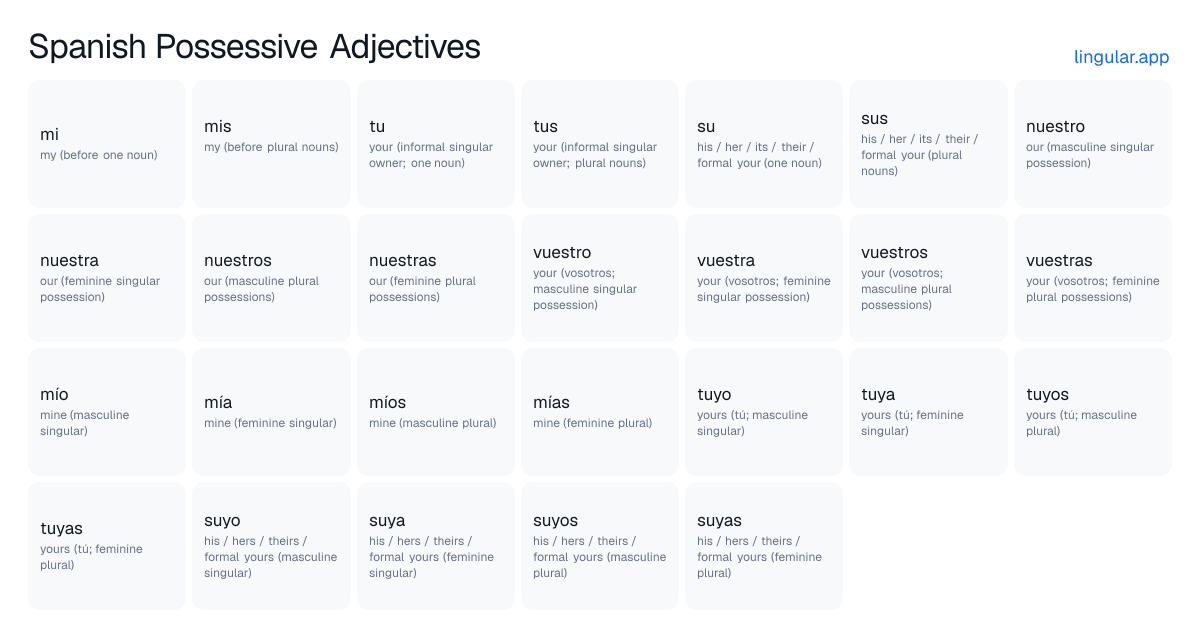
Learn all 26 distinct possessive forms and match each one to the thing possessed.
Step 1 of 3
Spanish possessives before a noun
Mi, tu and su go before a noun. Add -s when the thing possessed is plural: mi libro, mis libros.
Su can mean his, her, its, their, or formal your. Clarify the owner with de Ana, de él or de usted when needed.
mimy (before one noun) · MEE
mismy (before plural nouns) · MEES
tuyour (informal singular owner; one noun) · TOO
tusyour (informal singular owner; plural nouns) · TOOS
suhis / her / its / their / formal your (one noun) · SOO
sushis / her / its / their / formal your (plural nouns) · SOOS
Nuestro and vuestro: gender and number
Nuestro and vuestro agree with the thing possessed, not the owner’s gender: nuestro padre, nuestra madre.
Vuestro goes with vosotros/vosotras, mainly in Spain. Ustedes uses su/sus. Review subject pronouns for the owner forms. These eight forms also work after nouns, so they are listed only once.
Pick a word to hear it and see when it's due next.
0 / 26 learnt
Spanish Possessive Adjectives: the full list
Review the vocabulary by topic, then use the printable worksheet to check your recall.
Quick answer:my (before one noun) is mi, my (before plural nouns) is mis, your (informal singular owner; one noun) is tu, your (informal singular owner; plural nouns) is tus, his / her / its / their / formal your (one noun) is su, and his / her / its / their / formal your (plural nouns) is sus.