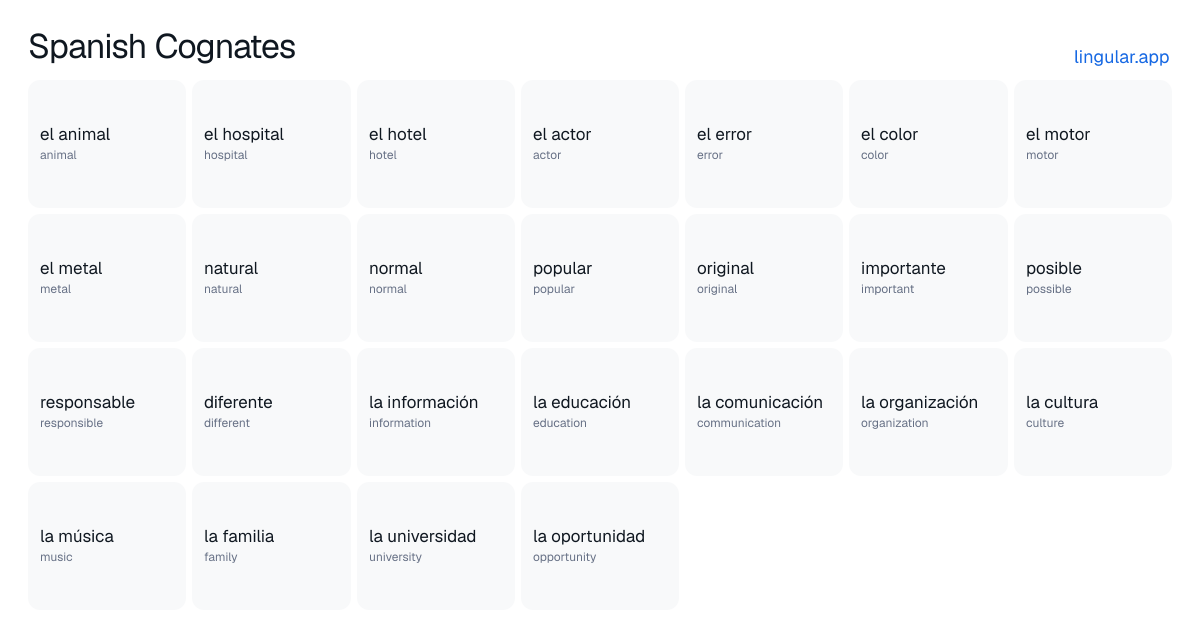
Recognize familiar roots while learning Spanish endings, articles and pronunciation.
Step 1 of 3
Spanish cognates with familiar spellings
A cognate shares a historical root with a word in another language. Similar spelling is a clue, but Spanish pronunciation and noun gender still need practice.
Many adjectives keep recognizable endings: natural, normal and popular. They do not change for gender, but add -es in the plural.
Final -e in importante is pronounced. See adjectives for agreement.
naturalnatural · nah-too-RAHL
normalnormal · nor-MAHL
popularpopular · poh-poo-LAHR
originaloriginal · oh-ree-hee-NAHL
importanteimportant · eem-por-TAHN-teh
posiblepossible · poh-SEE-bleh
responsableresponsible · rrehs-pohn-SAH-bleh
diferentedifferent · dee-feh-REHN-teh
English and Spanish cognate ending patterns
English -tion often corresponds to Spanish -ción. These nouns are usually feminine, and the written accent marks the stressed final syllable.
Patterns help recognition; they are not automatic translation rules. Learn each whole word and its meaning.
la informacióninformation · lah een-for-mah-SYOHN
la educacióneducation · lah eh-doo-kah-SYOHN
la comunicacióncommunication · lah koh-moo-nee-kah-SYOHN
la organizaciónorganization · lah or-gah-nee-sah-SYOHN
la culturaculture · lah kool-TOO-rah
la músicamusic · lah MOO-see-kah
la familiafamily · lah fah-MEE-lyah
la universidaduniversity · lah oo-nee-behr-see-DAHD
la oportunidadopportunity · lah oh-por-too-nee-DAHD
learnt
0
mastered
0
learning
0
struggling
0
due for review
0
Learning Learnt Mastered Struggling
Pick a word to hear it and see when it's due next.
0 / 25 learnt
Spanish Cognates: full list
Review the meanings, pronunciation and usage notes, then use the printable worksheet to recall the Spanish.
Quick answer:animal is el animal, hospital is el hospital, hotel is el hotel, actor is el actor, error is el error, color is el color, motor is el motor, and metal is el metal.