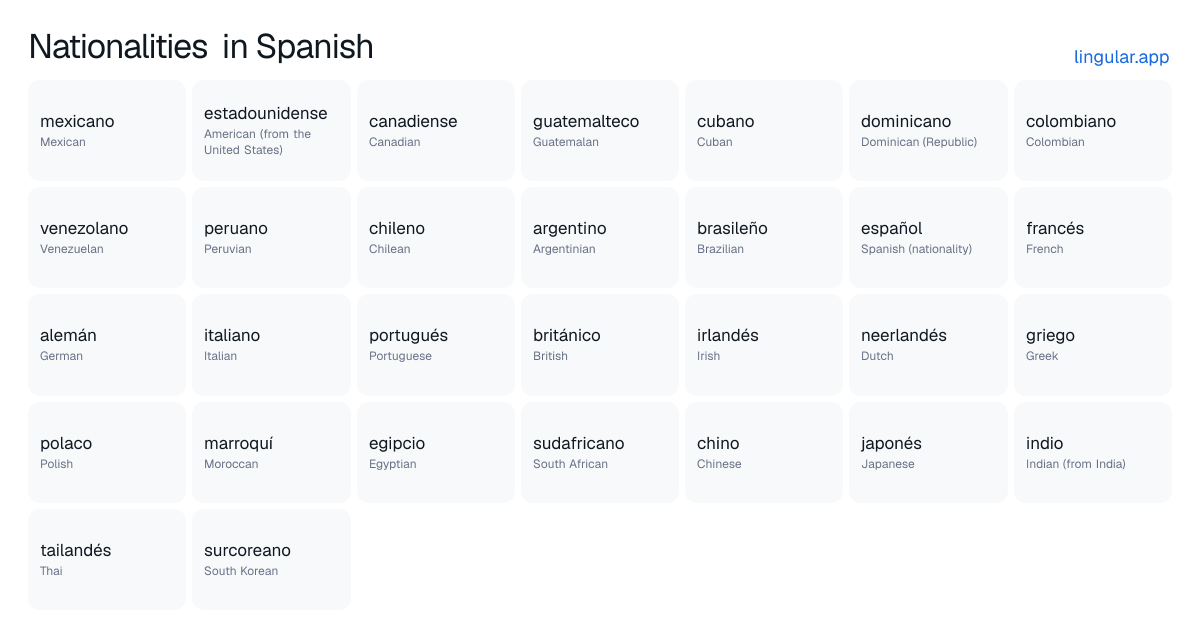
An adjective ending in -és often adds -a and loses its accent: francés → francesa. Español → española also adds -a.
Use ser for nationality: soy italiana. See subject pronouns for the people these forms describe.
españolSpanish (nationality) · ehs-pah-NYOHL
francésFrench · frahn-SEHS
alemánGerman · ah-leh-MAHN
italianoItalian · ee-tah-LYAH-noh
portuguésPortuguese · por-too-GEHS
británicoBritish · bree-TAH-nee-koh
irlandésIrish · eer-lahn-DEHS
neerlandésDutch · neh-ehr-lahn-DEHS
griegoGreek · GRYEH-goh
polacoPolish · poh-LAH-koh
African and Asian nationalities in Spanish
Marroquí does not change for gender; its usual plural is marroquíes. india can be a feminine nationality adjective, while India with a capital names the country.
Surcoreano specifies South Korean. Learn the whole adjective because the relationship to the country name is not always obvious.
marroquíMoroccan · mah-rroh-KEE
egipcioEgyptian · eh-HEEP-syoh
sudafricanoSouth African · soo-dah-free-KAH-noh
chinoChinese · CHEE-noh
japonésJapanese · hah-poh-NEHS
indioIndian (from India) · EEN-dyoh
tailandésThai · ty-lahn-DEHS
surcoreanoSouth Korean · soor-koh-reh-AH-noh
learnt
0
mastered
0
learning
0
struggling
0
due for review
0
Learning Learnt Mastered Struggling
Pick a word to hear it and see when it's due next.
0 / 30 learnt
Nationalities in Spanish: the full list
Review the meanings and pronunciation, then use the printable worksheet to recall each Spanish answer.
Quick answer:Mexican is mexicano, American (from the United States) is estadounidense, Canadian is canadiense, Guatemalan is guatemalteco, Cuban is cubano, Dominican (Republic) is dominicano, Colombian is colombiano, Venezuelan is venezolano, Peruvian is peruano, Chilean is chileno, Argentinian is argentino, and Brazilian is brasileño.