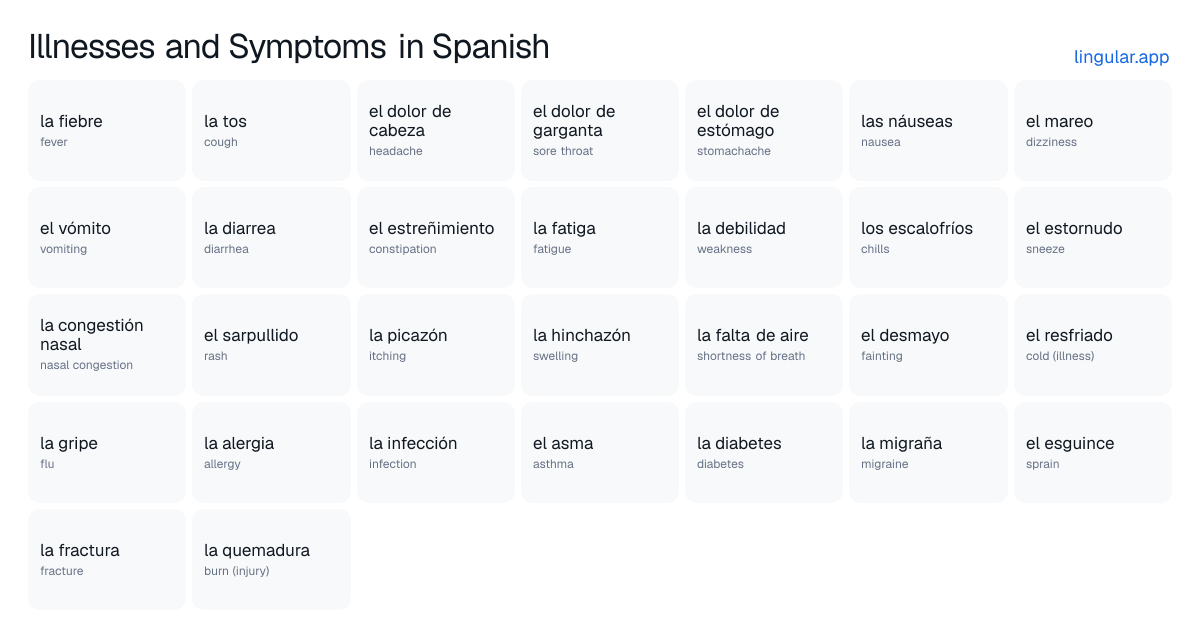
Learn the Spanish names of common illnesses, symptoms and injury terms.
Step 1 of 3
Common symptoms in Spanish
La fiebre is fever and la tos is a cough. El dolor de cabeza is a headache; dolor de names pain in a body part.
This page teaches vocabulary meanings. Use body parts in Spanish to recognize the words inside symptom terms.
la fiebrefever · lah FYEH-breh
la toscough · lah TOHS
el dolor de cabezaheadache · el doh-LOR deh kah-BEH-sah
el dolor de gargantasore throat · el doh-LOR deh gahr-GAHN-tah
el dolor de estómagostomachache · el doh-LOR deh ehs-TOH-mah-goh
las náuseasnausea · lahs NOW-seh-ahs
el mareodizziness · el mah-REH-oh
el vómitovomiting · el BOH-mee-toh
la diarreadiarrhea · lah dyah-REH-ah
el estreñimientoconstipation · el ehs-treh-nyee-MYEHN-toh
More Spanish symptom words
El cansancio means tiredness; la debilidad is weakness. El mareo is a broader word than el vértigo, which often describes a spinning sensation.
Estreñimiento means constipation. The similar-looking constipado can mean a cold in Spain, so it is not a reliable translation for constipation.
la fatigafatigue · lah fah-TEE-gah
la debilidadweakness · lah deh-bee-lee-DAHD
los escalofríoschills · lohs ehs-kah-loh-FREE-ohs
el estornudosneeze · el ehs-tor-NOO-doh
la congestión nasalnasal congestion · lah kohn-hehs-TYOHN nah-SAHL
el sarpullidorash · el sahr-poo-YEE-doh
la picazónitching · lah pee-kah-SOHN
la hinchazónswelling · lah een-chah-SOHN
la falta de aireshortness of breath · lah FAHL-tah deh AHY-reh
el desmayofainting · el dehs-MAH-yoh
Spanish illness and injury names
El resfriado and la gripe are different illness names: a cold and the flu. Regional resfrío is also accepted.
El síntoma is masculine despite ending in -a. Here the focus is recognizing terms, not using a symptom list to determine a diagnosis.
el resfriadocold (illness) · el rehs-FRYAH-doh
la gripeflu · lah GREE-peh
la alergiaallergy · lah ah-LEHR-hyah
la infeccióninfection · lah een-fehk-SYOHN
el asmaasthma · el AHS-mah
la diabetesdiabetes · lah dyah-BEH-tehs
la migrañamigraine · lah mee-GRAH-nyah
el esguincesprain · el ehs-GEEN-seh
la fracturafracture · lah frahk-TOO-rah
la quemaduraburn (injury) · lah keh-mah-DOO-rah
learnt
0
mastered
0
learning
0
struggling
0
due for review
0
Learning Learnt Mastered Struggling
Pick a word to hear it and see when it's due next.
0 / 30 learnt
Illnesses and Symptoms in Spanish: the full list
Review the vocabulary by topic, then use the printable worksheet to check your recall.
Quick answer:fever is la fiebre, cough is la tos, headache is el dolor de cabeza, sore throat is el dolor de garganta, stomachache is el dolor de estómago, nausea is las náuseas, dizziness is el mareo, vomiting is el vómito, diarrhea is la diarrea, and constipation is el estreñimiento.