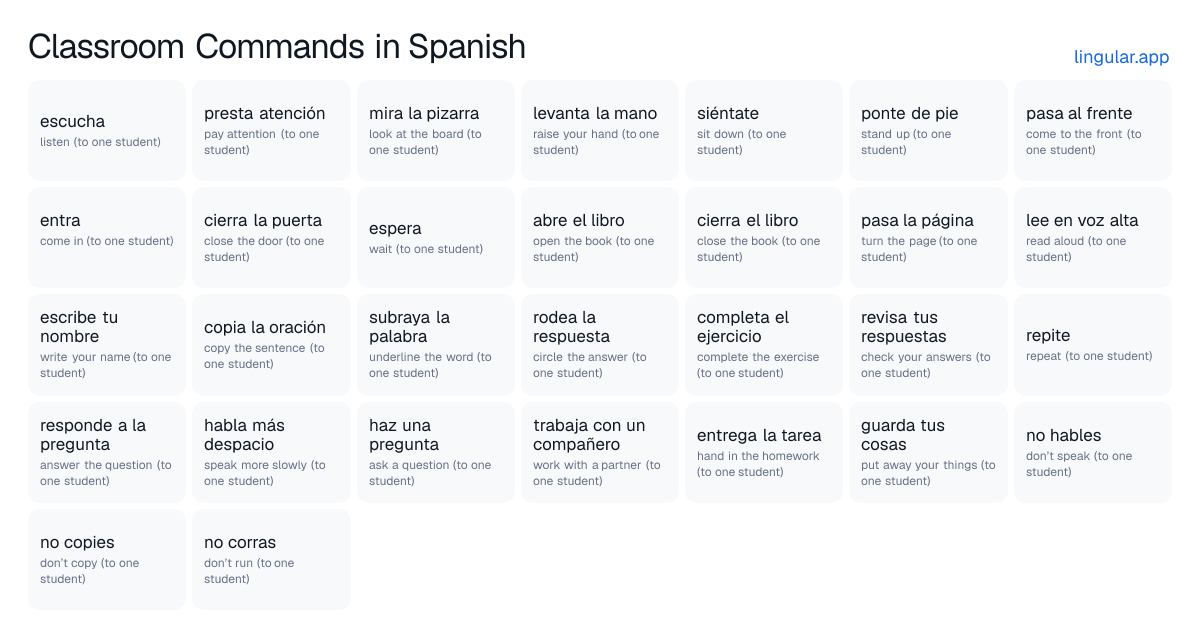
Understand common teacher instructions for listening, reading, writing and working together.
Step 1 of 3
Spanish classroom commands for one student
These commands address one student informally with tú. A teacher addressing a class in Latin America usually uses ustedes, such as escuchen.
The verb forms are fixed classroom instructions. Match the objects with school supplies.
escuchalisten (to one student) · ehs-KOO-chah
presta atenciónpay attention (to one student) · PREHS-tah ah-tehn-SYOHN
mira la pizarralook at the board (to one student) · MEE-rah lah pee-SAH-rrah
levanta la manoraise your hand (to one student) · leh-BAHN-tah lah MAH-noh
siéntatesit down (to one student) · SYEHN-tah-teh
ponte de piestand up (to one student) · POHN-teh deh PYEH
pasa al frentecome to the front (to one student) · PAH-sah ahl FREHN-teh
entracome in (to one student) · EHN-trah
cierra la puertaclose the door (to one student) · SYEH-rrah lah PWEHR-tah
esperawait (to one student) · ehs-PEH-rah
Spanish classroom instructions for written work
Affirmative commands can attach pronouns: léelo, read it. These examples keep the task and object explicit so you can recognize the full instruction.
Written accents preserve the stress in página and oración. Subrayar means to underline, not highlight.
abre el libroopen the book (to one student) · AH-breh el LEE-broh
cierra el libroclose the book (to one student) · SYEH-rrah el LEE-broh
pasa la páginaturn the page (to one student) · PAH-sah lah PAH-hee-nah
lee en voz altaread aloud (to one student) · LEH-eh ehn bohs AHL-tah
escribe tu nombrewrite your name (to one student) · ehs-KREE-beh too NOHM-breh
copia la oracióncopy the sentence (to one student) · KOH-pyah lah oh-rah-SYOHN
subraya la palabraunderline the word (to one student) · soob-RRAH-yah lah pah-LAH-brah
rodea la respuestacircle the answer (to one student) · rroh-DEH-ah lah rrehs-PWEHS-tah
completa el ejerciciocomplete the exercise (to one student) · kohm-PLEH-tah el eh-hehr-SEE-syoh
revisa tus respuestascheck your answers (to one student) · rreh-BEE-sah toos rrehs-PWEHS-tahs
Spanish classroom commands for speaking and tasks
A negative tú command uses a different form: habla, speak, but no hables, don’t speak. Learn the whole instruction rather than adding no to any command.
For group work, trabaja con un compañero addresses one student about collaborating with a partner.
repiterepeat (to one student) · rreh-PEE-teh
responde a la preguntaanswer the question (to one student) · rrehs-POHN-deh ah lah preh-GOON-tah
habla más despaciospeak more slowly (to one student) · AH-blah mahs dehs-PAH-syoh
haz una preguntaask a question (to one student) · AHS oo-nah preh-GOON-tah
trabaja con un compañerowork with a partner (to one student) · trah-BAH-hah kohn oon kohm-pah-NYEH-roh
entrega la tareahand in the homework (to one student) · ehn-TREH-gah lah tah-REH-ah
guarda tus cosasput away your things (to one student) · GWAHR-dah toos KOH-sahs
no hablesdon’t speak (to one student) · noh AH-blehs
no copiesdon’t copy (to one student) · noh KOH-pyehs
no corrasdon’t run (to one student) · noh KOH-rrahs
learnt
0
mastered
0
learning
0
struggling
0
due for review
0
Learning Learnt Mastered Struggling
Pick a word to hear it and see when it's due next.
0 / 30 learnt
Classroom Commands in Spanish: the full list
Review the meanings and pronunciation, then use the printable worksheet to recall each Spanish answer.
Quick answer:listen (to one student) is escucha, pay attention (to one student) is presta atención, look at the board (to one student) is mira la pizarra, raise your hand (to one student) is levanta la mano, sit down (to one student) is siéntate, stand up (to one student) is ponte de pie, come to the front (to one student) is pasa al frente, come in (to one student) is entra, close the door (to one student) is cierra la puerta, and wait (to one student) is espera.
Escucha addresses one student informally. Escuchen addresses a group using ustedes.
How do you say raise your hand in Spanish?
Levanta la mano is the informal singular command. Levanten la mano addresses a group with ustedes.
Why is sit down siéntate?
Siéntate is the affirmative tú command of sentarse with te attached. Its accent preserves the stressed syllable.
How do negative classroom commands work?
Negative tú commands use forms such as no hables and no corras. They differ from affirmative habla and corre.
Does pizarra mean blackboard or whiteboard?
Pizarra can refer to either, with context or an adjective specifying the type. Pizarrón is another regional term.
Are these commands for a whole class?
The practice prompts explicitly address one student with tú. Group commands commonly use ustedes in Latin America and vosotros in informal contexts in Spain.