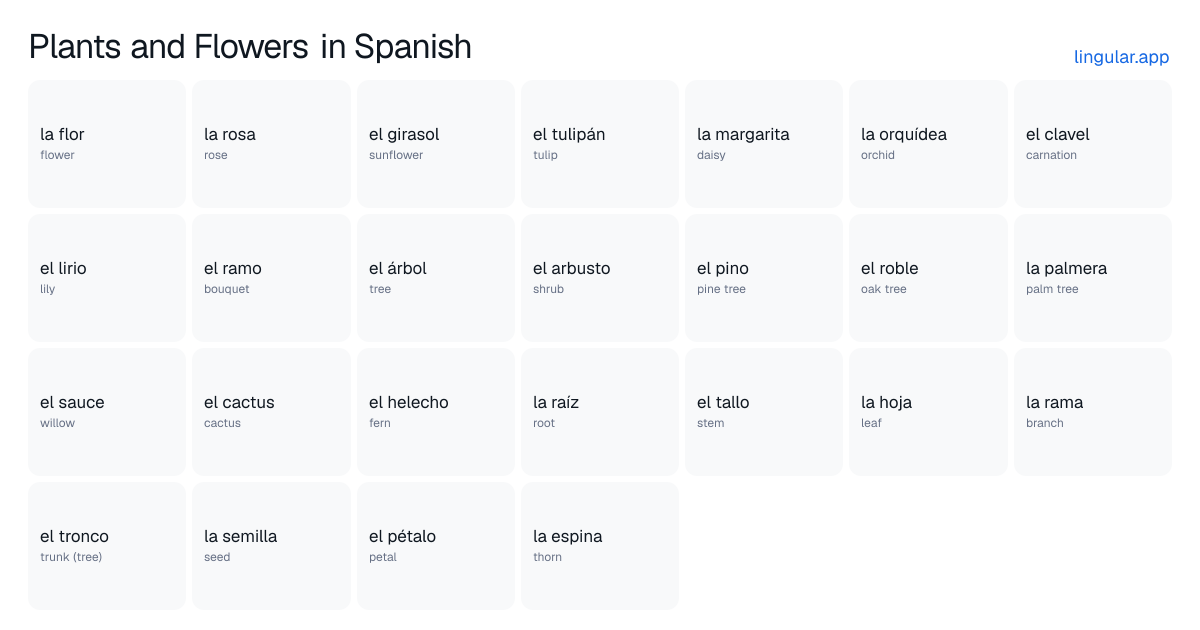
El árbol is the general word for tree; el arbusto is a shrub. A palmera is a palm tree, not the palm of your hand.
Cactus has the same singular and plural spelling: el cactus, los cactus.
el árboltree · el AHR-bohl
el arbustoshrub · el ahr-BOOS-toh
el pinopine tree · el PEE-noh
el robleoak tree · el RROH-bleh
la palmerapalm tree · lah pahl-MEH-rah
el saucewillow · el SAU-seh
el cactuscactus · el KAHK-toos
el helechofern · el eh-LEH-choh
Parts of a plant in Spanish
La raíz grows below the surface; el tallo supports the leaves and flowers. A tree’s main woody stem is el tronco.
The plural of raíz is raíces: the spelling changes from z to c before e.
la raízroot · lah rrah-EES
el tallostem · el TAH-yoh
la hojaleaf · lah OH-hah
la ramabranch · lah RRAH-mah
el troncotrunk (tree) · el TROHN-koh
la semillaseed · lah seh-MEE-yah
el pétalopetal · el PEH-tah-loh
la espinathorn · lah ehs-PEE-nah
learnt
0
mastered
0
learning
0
struggling
0
due for review
0
Learning Learnt Mastered Struggling
Pick a word to hear it and see when it's due next.
0 / 25 learnt
Plants and Flowers in Spanish: full list
Review the meanings, pronunciation and usage notes, then use the printable worksheet to recall the Spanish.
Quick answer:flower is la flor, rose is la rosa, sunflower is el girasol, tulip is el tulipán, daisy is la margarita, orchid is la orquídea, carnation is el clavel, lily is el lirio, and bouquet is el ramo.