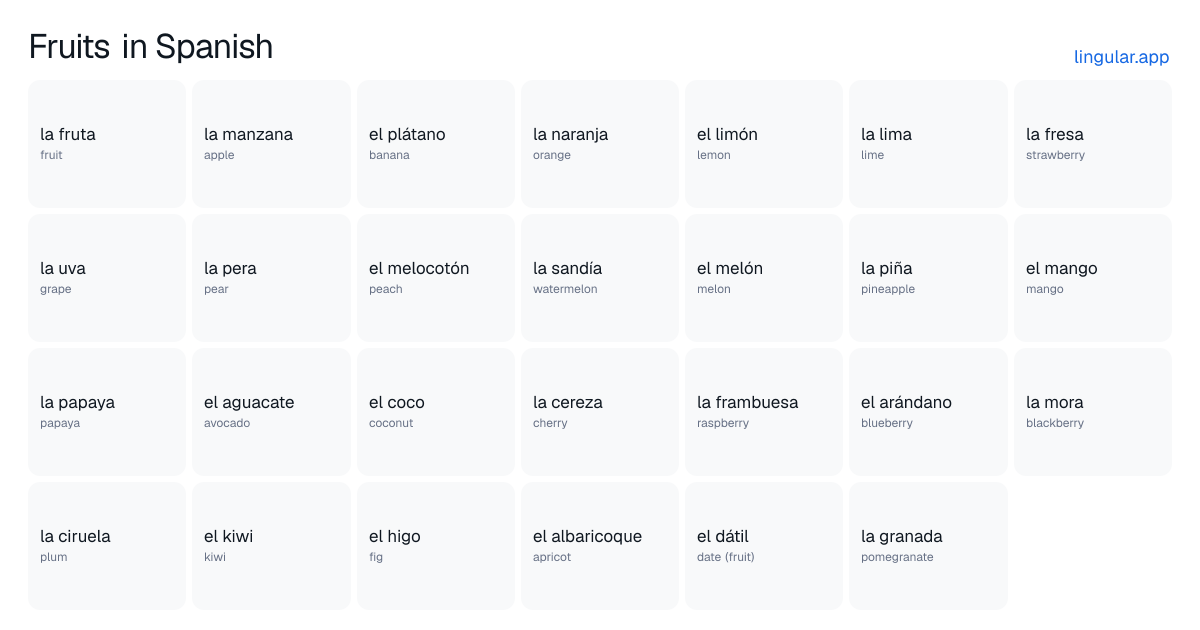
Everyday and tropical fruits, berries and stone fruits, with pronunciation and regional alternatives.
Step 1 of 3
Common fruits in Spanish
Fruit names change by country more than most words: a banana is plátano in Spain and Mexico, banana in Argentina, guineo in Puerto Rico. Meals, meat and drinks are on the food and drinks page.
la frutafruit · lah FROO-tah
la manzanaapple · lah mahn-SAH-nah
el plátanobanana · el PLAH-tah-noh
la naranjaorange · lah nah-RAHN-hah
el limónlemon · el lee-MOHN
la limalime · lah LEE-mah
la fresastrawberry · lah FREH-sah
la uvagrape · lah OO-bah
la perapear · lah PEH-rah
el melocotónpeach · el meh-loh-koh-TOHN
la sandíawatermelon · lah sahn-DEE-ah
el melónmelon · el meh-LOHN
Tropical fruits in Spanish
Avocado is aguacate in Mexico and Spain and palta in the Southern Cone. Vegetables now have their own vegetables lesson.
la piñapineapple · lah PEE-nyah
el mangomango · el MAHN-goh
la papayapapaya · lah pah-PAH-yah
el aguacateavocado · el ah-gwah-KAH-teh
el cocococonut · el KOH-koh
Berries and stone fruits in Spanish
Strawberry is fresa or frutilla, depending on the country. Apricot is albaricoque, damasco or chabacano.
la cerezacherry · lah seh-REH-sah
la frambuesaraspberry · lah frahm-BWEH-sah
el arándanoblueberry · el ah-RAHN-dah-noh
la morablackberry · lah MOH-rah
la ciruelaplum · lah see-RWEH-lah
el kiwikiwi · el KEE-wee
el higofig · el EE-goh
el albaricoqueapricot · el ahl-bah-ree-KOH-keh
el dátildate (fruit) · el DAH-teel
la granadapomegranate · lah grah-NAH-dah
learnt
0
mastered
0
learning
0
struggling
0
due for review
0
Learning Learnt Mastered Struggling
Pick a word to hear it and see when it's due next.
0 / 27 learnt
Fruits in Spanish: the full list
Every term with pronunciation and notes. Use the printable worksheet to test yourself.
Quick answer:fruit is la fruta, apple is la manzana, banana is el plátano, orange is la naranja, lemon is el limón, lime is la lima, strawberry is la fresa, grape is la uva, pear is la pera, peach is el melocotón, watermelon is la sandía, and melon is el melón.