Morning routine verbs in Spanish
These are dictionary-form verbs: desayunar , to eat breakfast, becomes desayuno , I eat breakfast. Practice the infinitive here.
This lesson focuses on everyday non-reflexive actions and schedule nouns. Reflexive forms such as levantarse need their own pronoun patterns.
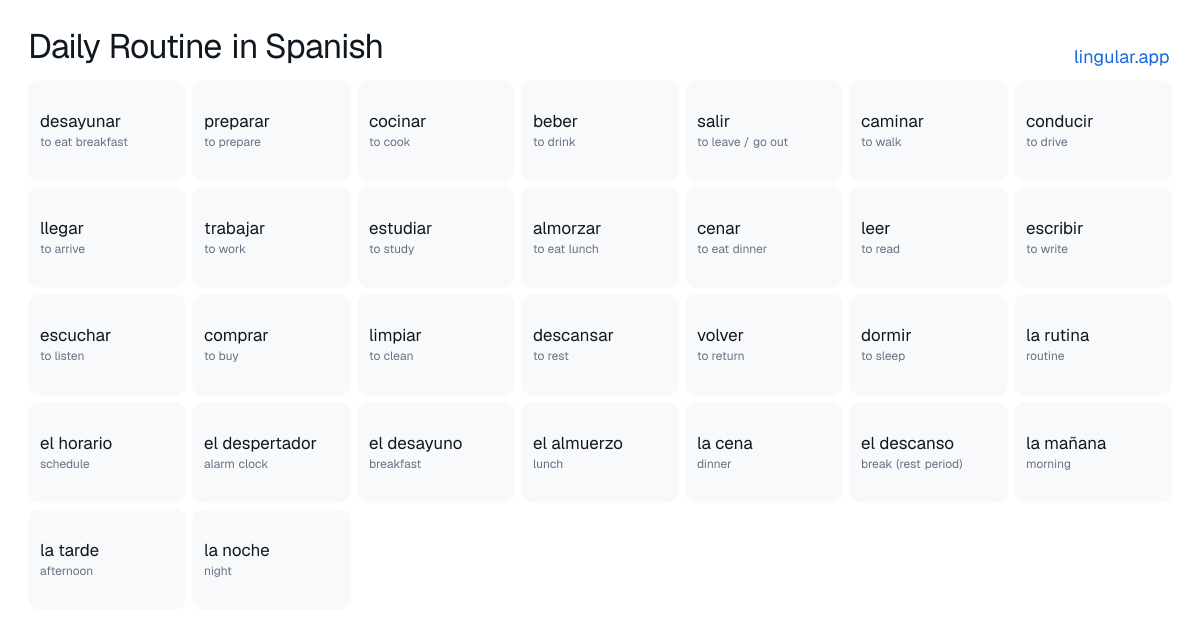
desayunar to eat breakfast · deh-sah-yoo-NAHR preparar to prepare · preh-pah-RAHR cocinar to cook · koh-see-NAHR beber to drink · beh-BEHR salir to leave / go out · sah-LEER caminar to walk · kah-mee-NAHR conducir to drive · kohn-doo-SEER llegar to arrive · yeh-GAHR trabajar to work · trah-bah-HAHR estudiar to study · ehs-too-DYAHR Daily activity verbs in Spanish
Almorzar means to eat lunch, and cenar means to eat dinner. Exact mealtimes depend on the country and household.
After soler , use an infinitive: suelo leer , I usually read. Find more actions in common verbs .
almorzar to eat lunch · ahl-mor-SAHR cenar to eat dinner · seh-NAHR leer to read · leh-EHR escribir to write · ehs-kree-BEER escuchar to listen · ehs-koo-CHAHR comprar to buy · kohm-PRAHR limpiar to clean · leem-PYAHR descansar to rest · dehs-kahn-SAHR volver to return · bohl-BEHR dormir to sleep · dor-MEER Spanish words for a daily schedule
La mañana is the morning; mañana without an article can mean tomorrow. La madrugada is the period after midnight and before dawn.
Use telling-time words to add clock times to your routine.
la rutina routine · lah roo-TEE-nah el horario schedule · el oh-RAH-ryoh el despertador alarm clock · el dehs-pehr-tah-DOR el desayuno breakfast · el deh-sah-YOO-noh el almuerzo lunch · el ahl-MWEHR-soh la cena dinner · lah SEH-nah el descanso break (rest period) · el dehs-KAHN-soh la mañana morning · lah mah-NYAH-nah la tarde afternoon · lah TAHR-deh la noche night · lah NOH-cheh Next: Day and evening actions ›
learnt 0
mastered 0
learning 0
struggling 0
due for review 0 to eat breakfast to prepare to cook to drink to leave / go out to walk to drive to arrive to work to study to eat lunch to eat dinner to read to write to listen to buy to clean to rest to return to sleep routine schedule alarm clock breakfast lunch dinner break (rest period) morning afternoon night
Pick a word to hear it and see when it's due next.