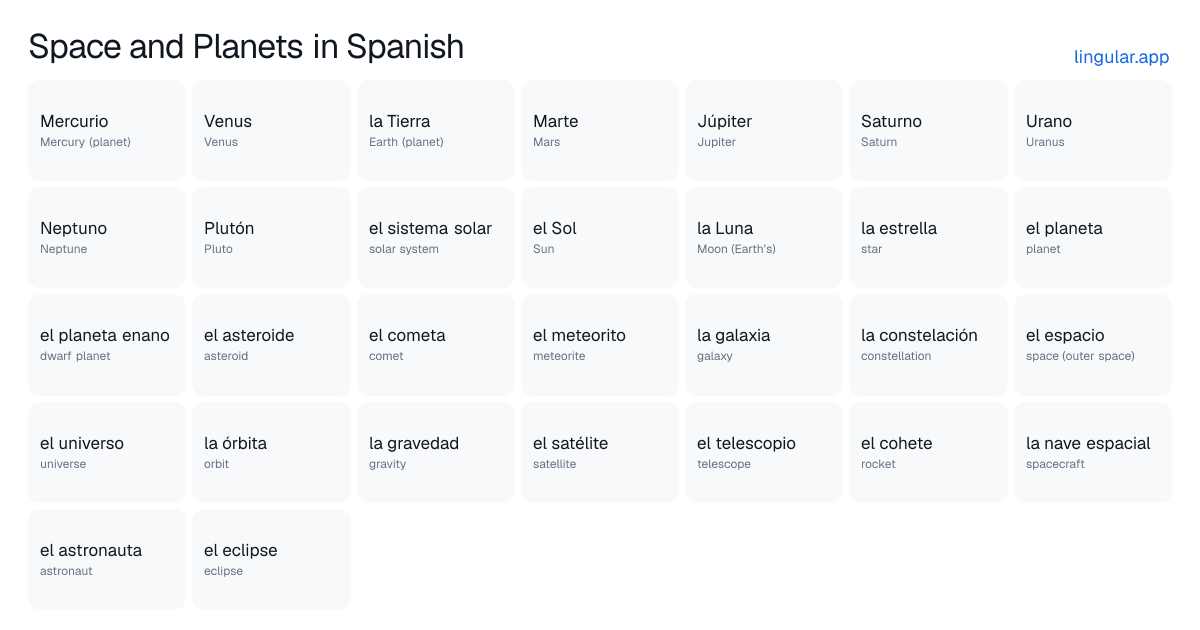
Learn the eight planets, objects in space and the words used to observe and explore them.
Step 1 of 3
The eight planets in Spanish
The eight planet names are proper names and begin with capitals. La Tierra names our planet, while lowercase tierra can mean earth or soil.
Plutón is a dwarf planet. It is included alongside the eight planets with its classification explained, rather than counted as a ninth planet.
MercurioMercury (planet) · mehr-KOOR-yoh
VenusVenus · BEH-noos
la TierraEarth (planet) · lah TYEH-rrah
MarteMars · MAHR-teh
JúpiterJupiter · HOO-pee-tehr
SaturnoSaturn · sah-TOOR-noh
UranoUranus · oo-RAH-noh
NeptunoNeptune · nehp-TOO-noh
PlutónPluto · ploo-TOHN
el sistema solarsolar system · el sees-TEH-mah soh-LAHR
Stars, moons and galaxies in Spanish
Una estrella produces its own light; un planeta orbits a star. La Luna names Earth’s moon, while una luna can describe another natural satellite.
Meteoro describes an atmospheric phenomenon; meteorito names a piece that reaches the ground.
el SolSun · el SOHL
la LunaMoon (Earth’s) · lah LOO-nah
la estrellastar · lah ehs-TREH-yah
el planetaplanet · el plah-NEH-tah
el planeta enanodwarf planet · el plah-NEH-tah eh-NAH-noh
el asteroideasteroid · el ahs-teh-ROY-deh
el cometacomet · el koh-MEH-tah
el meteoritometeorite · el meh-teh-oh-REE-toh
la galaxiagalaxy · lah gah-LAHK-syah
la constelaciónconstellation · lah kohns-teh-lah-SYOHN
Spanish space exploration vocabulary
Órbita is orbit and gravedad is gravity. Un satélite may be natural or artificial, so context matters.
The astronauta ending stays the same for a man or woman: el astronauta, la astronauta, like several profession names.
el espaciospace (outer space) · el ehs-PAH-syoh
el universouniverse · el oo-nee-BEHR-soh
la órbitaorbit · lah OR-bee-tah
la gravedadgravity · lah grah-beh-DAHD
el satélitesatellite · el sah-TEH-lee-teh
el telescopiotelescope · el teh-lehs-KOH-pyoh
el coheterocket · el koh-EH-teh
la nave espacialspacecraft · lah NAH-beh ehs-pah-SYAHL
el astronautaastronaut · el ahs-troh-NOW-tah
el eclipseeclipse · el eh-KLEEP-seh
learnt
0
mastered
0
learning
0
struggling
0
due for review
0
Learning Learnt Mastered Struggling
Pick a word to hear it and see when it's due next.
0 / 30 learnt
Space and Planets in Spanish: the full list
Review the meanings and pronunciation, then use the printable worksheet to recall each Spanish answer.
Quick answer:Mercury (planet) is Mercurio, Venus is Venus, Earth (planet) is la Tierra, Mars is Marte, Jupiter is Júpiter, Saturn is Saturno, Uranus is Urano, Neptune is Neptuno, Pluto is Plutón, and solar system is el sistema solar.