Distinguish named holidays, days off and the traditions used to celebrate them.
Step 1 of 3
Names of holidays in Spanish
Named celebrations such as Navidad and Año Nuevo use capital letters. The words día and año stay lowercase in ordinary uses.
Compare holiday names with months when discussing dates. Observance and public-holiday status vary by country.
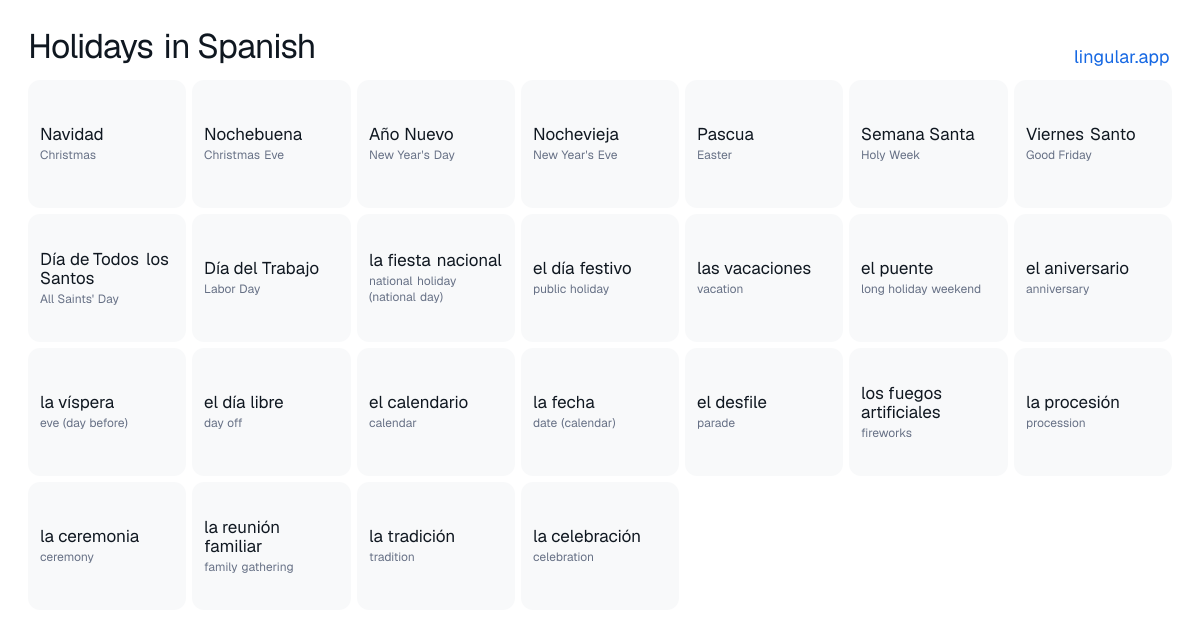
NavidadChristmas · nah-bee-DAHD
NochebuenaChristmas Eve · noh-cheh-BWEH-nah
Año NuevoNew Year's Day · AH-nyoh NWEH-boh
NocheviejaNew Year's Eve · noh-cheh-BYEH-hah
PascuaEaster · PAHS-kwah
Semana SantaHoly Week · seh-MAH-nah SAHN-tah
Viernes SantoGood Friday · BYEHR-nehs SAHN-toh
Día de Todos los SantosAll Saints' Day · DEE-ah deh TOH-dohs lohs SAHN-tohs
Día del TrabajoLabor Day · DEE-ah del trah-BAH-hoh
la fiesta nacionalnational holiday (national day) · lah FYEHS-tah nah-syoh-NAHL
Spanish words for holidays and time off
Un día festivo is a holiday on the calendar; las vacaciones are vacation time. They are not interchangeable translations of English holiday.
A puente is time off bridging a holiday and a weekend, sometimes including an extra working day.
el día festivopublic holiday · el DEE-ah fehs-TEE-boh
las vacacionesvacation · lahs bah-kah-SYOH-nehs
el puentelong holiday weekend · el PWEHN-teh
el aniversarioanniversary · el ah-nee-behr-SAH-ryoh
la vísperaeve (day before) · lah BEES-peh-rah
el día libreday off · el DEE-ah LEE-breh
el calendariocalendar · el kah-lehn-DAH-ryoh
la fechadate (calendar) · lah FEH-chah
Spanish words for holiday celebrations
A desfile is a parade, while a procesión is usually a religious or ceremonial procession. Fuegos artificiales means fireworks.
These words describe possible traditions; no single set of customs represents every country or family.
el desfileparade · el dehs-FEE-leh
los fuegos artificialesfireworks · lohs FWEH-gohs ahr-tee-fee-SYAH-lehs
la procesiónprocession · lah proh-seh-SYOHN
la ceremoniaceremony · lah seh-reh-MOH-nyah
la reunión familiarfamily gathering · lah rreh-oo-NYOHN fah-mee-LYAHR
la tradicióntradition · lah trah-dee-SYOHN
la celebracióncelebration · lah seh-leh-brah-SYOHN
learnt
0
mastered
0
learning
0
struggling
0
due for review
0
Learning Learnt Mastered Struggling
Pick a word to hear it and see when it's due next.
0 / 25 learnt
Holidays in Spanish: full list
Review the meanings, pronunciation and usage notes, then use the printable worksheet to recall the Spanish.
Quick answer:Christmas is Navidad, Christmas Eve is Nochebuena, New Year's Day is Año Nuevo, New Year's Eve is Nochevieja, Easter is Pascua, Holy Week is Semana Santa, Good Friday is Viernes Santo, All Saints' Day is Día de Todos los Santos, Labor Day is Día del Trabajo, and national holiday (national day) is la fiesta nacional.